Showing posts with label farewell. Show all posts

Monday, 31 December 2018

A fond farewell and a huge thank you - Day 32

New Year's Day, 1st January 2019


All good things come to an end, or so they say. I can tell from how wretched I feel writing this goodbye how lucky I am to have hosted the Advent Series for the past five years. (This adieu is my own personal "Heartache"). I have learned so much, made some amazing friends, strengthened bonds with others and discovered information about contacts that I would never have guessed had it not been for writing on here. I have unearthed more odd facts and chosen a larger number of illustrations and music for other people's pieces than I care to remember. It is humbling to see how the series has grown since 2014: it now has a wide, global following and contributions have been submitted from a range of locations around the world; writers have aged from teens and to grandparents and people facing up to growing old, and subjects have been equally wide from births and babies to fathersgrandmothers and elderly great aunts; and it has been wonderful to see how people who have joined in from various sectors (including HR, artisan cheesemaking, economics and forecasting, research, Tech, L&D, Facilitation, Facilities and Workplace Design, Artists and Consulting);  and a wide range of attitudes and opinions have been voiced, including through stories, autobiographical reminiscences, confessions of loss, comments on the landscape, and poems. I love the fact that the series is not commercial, it is something that has been created for a community out of individuals' consideration for others and the simple joy of writing something to share. Some people find contributing to the series cathartic or hope to help others, others wish to describe experiences, make a record of the year, or vital moments that have passed,  to share a sadness, talk about loved ones, make sense of the past,  extol a joy or inspirationlight the way, or simply find their voice - the series has been the launch pad for a number of now well known and respected bloggers.  I am not going to call names and single out specific posts - there have been far too many exceptional posts over the years although all the links above are to posts that proved particularly popular. Every blogger has left their mark and the series would have been the poorer for any loss of contributions. "High-fives" to each and every writer.

Being the curator, taking the series on after its initial foundation by Alison Chisnell, I have been privileged enough, to interact quite frequently with the people who have crafted blogs. When people have wished to remain anonymous I have tried hard to protect their identity. Some contributors have written posts that have helped others and which have commenced discussions on important matters such as mental health, bereavement, ageing, sustainability, the future, society and relationships. People have been so open and shared things that have often surprised others. I have learnt a lot from you, and many of you have inspired me and others in so many different ways. Thank you.

As you know, I am passing on the baton to a new curator - Gary Cookson. I am confident that under his stewardship the series will be enhanced and continue to thrive. The series has "become a thing" and I know that it will get bigger and better under Gary's careful eye. I look forward to being a contributor once again and crafting a piece for his chosen theme(s).

My "Hope" is that you all have a splendid 2019, full of joyous experiences, amusing incidents and handy tips that you will be able to use in the posts you craft for Gary near the end of the year.

FAREWELL and THANK YOU!


So long, farewell... and


Thank you!

Sunday, 16 December 2018

Finding Hope - Day 17

Monday 17th December
17 years is the period of time that some species of periodic cicada spend underground
as nymphs in between mating periods. It is believed that they have evolved do this to reduce
the impact of predators both by starving them, whilst their food source is safe
underground, and then by emerging simultaneously in such huge numbers that predators are
stated before all the cicadas can be consumed. I love the sound of cicadas - it reminds me of
my youth and growing up in Hong Kong or heady days spent on Greek islands.
Today will be both good, thankful and slightly wistful - I have a meeting in Cambridge to celebrate the end of the Queen's Young Leaders programme. It has been a genuine pleasure and honour to have been involved from the start. In 2014 a search was launched to find exceptional young people to receive the first ever Queen’s Young Leaders Awards. Hundreds of applications flooded in from incredible young people all dedicated to making lasting change in their community and beyond. The Programme has now come to an end, as this was its final year; it has formed a unique community of 240 influential change-makers, who represent 53 Commonwealth countries. I have mentored a few of them and watched in awe and respect as each of these extraordinary young people have each managed to make the word a better place. Congratulations to all involved. What a wonderful legacy in every way. Thank you to Her Majesty The Queen for having the initial concept and for making it possible

Today's post is by Niall GavinNiall is a much-liked and highly respected independent L&D and learning technologies specialist (after a successful career working in both the public and private sectors). He runs a company called ARG Training. Prior to helping people develop and grow, Niall spent some time as an actor, a postman and a fruit picker. He writes an enjoyable blog, A Little About a Lot and is active on social media, you can find him on Twitter (his handle is @niallgavinuk). He usually has some great insights that he shares on #LDinsight every Friday morning on Twitter. Niall lives near Worthing on the south coast of England. He is a devoted husband and father. In his spare time he enjoys walking and is also an "armchair astronomer". As you will see from what he has written, this year's Advent Blogs' theme struck a chord with him. 

************

As the theme of this year's Advent Blog series is "Heartaches, Hopes and High Fives", starting this blog is a no-brainer! I am my own best example of experiencing heartache. In April 2015, I developed Angina - actual, real, physical heart ache - the result of which was that two weeks later I had a triple cardiac bypass operation. I have previously blogged about that experience (https://niallgavinuk.blogspot.com/2015/06/heartfelt.html). 

That dealt with my previously unknown cardiac problems and my surgeon and consultant immediately pronounced me "good for another 25 years" (Not sure what that means for when I turn 85, but we'll cross that bridge when we come to it). And I'm still here. Hoorah!


But right now and, I suspect, like many, I am suffering emotional heartache. In a country dramatically divided over a vote on something that was never understood by the electorate and which played to the baser, biased, self-preservatory instincts of many, we find ourselves stepping into a horribly uncertain national future outside the European Union. 


I also look at what's happening in America and am still surprised how much actual, physical revulsion I experience when I see or hear the current Presidential incumbent speak and the blatant, shameless ignorance and willful blindness to fact that his narcissistic persona plays out on the global stage.  


And don't get me started on global warming and species extinction! It's a world that I don't recognise and am embarrassed and upset to be handing over eventually to my - and your - children to work through and sort out. That hurts my heart too.


So the challenge now is to be hopeful, to find something to be hopeful about. I'm struggling with this right now and I find myself wanting in this regard, with a sense of personal impotence and, yes, even despair about these things. My hopes lie in the next generation, my own children, their contemporaries and peers, and in the work that I am doing with Apprentices at our local college. I am working hard with them all to try to encourage and develop a sense of curiosity, of challenge, to see themselves as current and future professionals and citizens, whose voice and actions will make a difference and contribute to a safe, sustainable and secure future for all. As a father and a skills development facilitator, it's my best attempt to 'make up' for the mess we're in and equip them with the resilience and skills they'll need to cope with and/or fix it, if we haven't done so together before we move on and leave them to it. They will carry my hopes with them.


Maybe that's where we could all be focussing a larger part of our attention and efforts now. I know many who are. I hope that I can too.

And finally, my High Five. As Kate Griffiths-Lambeth announces that she's handing over the curation and publication of the Advent Blog series - to the excellent Gary Cookson (@Gary_Cookson) - I can think of no-one better deserving of our thanks and best wishes for the future than Kate herself. In the midst of her own personal challenges, she has inspired many of us to contribute to the series over the years, enhanced our humble contributions and ensured the continuation of what has become a high point of the festive calendar. BIG High Five, Kate, right there!

Nice to finish what has been a difficult blog to write on a positive, grateful note. Happy Holidays.


Note from the curator

Sunday, 27 September 2015

The Art of Leaving

From being a teenager onwards my father has delighted in teasing me with the following rhyme (written by Ogden Nash in the 1930s, when women wearing trousers were frowned upon): 
Sure, deck your lower limbs in pants;

Yours are the limbs, my sweeting.
You look divine as you advance –
Have you seen yourself retreating?


This is neither a post about sartorial elegance nor a debate as to whether the female figure suits a skirt better than britches, instead it is a few thoughts on “retreating” – leaving a job and saying goodbye.
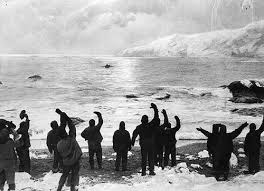
The Antarctic survivors on Elephant Island waving farewell
to Shackleton and the James Caird crew, April 24 1916
 

During my career I have encountered many “retreats”, some simple resignations because an employee has an attractive offer that will forward their career or quality of life, others forced departures due to sickness, personal circumstances, inappropriate conduct or business need. I must confess to finding the latter, which are predominantly accomplished through redundancies, particularly challenging, as they impact on people’s lives and yet the exit decisions are made by the business according to organisationally defined criteria, often with little thought to the impact that verdicts will have on the individuals and their families. No matter how much you stress that the exits are not a reflection on those who are impacted (both the people leaving and those left behind), but are based on an assessment of the roles they fulfil, it is hard for those selected (unless they have opted for voluntary redundancy) not to feel their forced departure on a very personal level.  I see one of business leaders’ and HR’s primary roles as ensuring that leavers, as well as joiners, have as good an experience as possible.


I discovered yesterday that I have been included in a book, How To Stand Out, by Dr. Rob Yeung, the leading UK psychologist, author and orator – he and I have known each other for over a decade, having worked together and I hold him and his work in high regard. Nearly a year ago, we had an interesting discussion about careers, values and impact; I thought what I had said were just words lost in the breeze at the end of the evening, but, in addition to acknowledging my desire to continuously learn and grow, he picked up on my determination to always treat people with respect and understanding, especially during times of change and transition. In the book he has used some examples from my past to illustrate how businesses can achieve the best outcomes both for themselves and exiting employees.  In 2008/9 my team and I went out of our way to secure new roles for people who were being made redundant, when we had to lay off 20% of the workforce. We flew HR directors and recruiters in from overseas locations where there were opportunities, to enable them to select their new hires from our excellent staff. All parties were happy with the outcome. In my opinion, the world would be a better place if more people considered the impact they have on those around them and made an effort to soften the blow, so that those leaving and those left behind can get on with life without undue anxiety. Seven years later I am still in contact with (and friends with) many of the people who set out on new paths at that time. Some have even thanked me for the opportunity it presented that has changed their lives for the better and commented on the consideration I showed during tough times – even now their comments are a truly humbling experience.


The need for respect works both ways – when a person chooses to leave their employer, the manner in which they resign and then conduct themselves in the lead up to and following their departure is important.  In reality, few people wish to go leaving a lasting bad taste in the mouth of their former boss and colleagues (and this is not just because they are concerned at getting a bad reference); who knows what the future will hold? I have on more than one occasion been involved in an acquisition where there are employees on the other side who find themselves becoming colleagues again with people they thought they had said “goodbye” to. So, my advice is be careful what you say in your resignation letter – although, there are times when you have a duty to inform the company as to what is causing your departure, especially if ethics or workplace issues are involved. If there are things that can be done to make a better environment then you have a duty to explain, as the information should be used to improve the workplace for others after you have gone. 


One of the most popular resignation themed posts on Forbes is a very frank explanation by a recruiter as to why she felt compelled to leave. It is clear from follow up interviews with her that she has no regrets at being so honest and that her letter has acted as inspiration for others. However, a resignation should not simply be an opportunity for revenge and bad-mouthing. 


Despite the end of the Job-for-life there is a duty of trust and care that rests on both an employee and their employer. Individuals are expected to work to the best of their ability whilst employed, in exchange for a salary and benefits, the chance to develop and a suitable place to work; in return an employer should respect those who toil for the benefit of the business. Managers and leaders should do their best to treat staff with courtesy – communicating in an honest and open manner, paying a fair wage and treating employees with trust and appreciation.


Advice to those about to leave: 
  • tell your boss first, before you speak with others– your manager/supervisor should never find out via someone else that you are planning to go;
  • discuss the timing of your departure and, if needs be, agree to stay until a certain matter is concluded or goal achieved;
  • once the decision is made and public, refrain from talking overmuch about your new opportunity;
  • stay focused on what needs to be done to ensure a professional departure; remain considerate to others especially as some of them may be having to take on some of your tasks and responsibilities;
  • offer to help and leave detailed notes or provide a personal handover for those who will have to pick up where you will leave off;
  • be appreciative - use the opportunity of your departure to thank people and provide feedback  to them (positive as well as constructive) – this may be your most important legacy; and
  • contemplate what went well and what you could have done better in your old role - were there things you loved or are particularly pleased to have done? Are there situations, types of people or aspects of your job that you should avoid in the future? Learn from your mistakes and figure out how to improve on your triumphs, so that you can develop your skills and be even better in your next role.


The best departures are those where you appreciate that the time is right to go but retain the memories and an appreciation of the benefits and the good things you gained from the time with your employer and colleagues.. In the words of the Pulitzer Prize winner, Ellen Goodman:

There’s a trick to the Graceful Exit. It begins with the vision to recognise when a job, a life stage, a relationship is over – and to let go. It means leaving what’s over without denying its value.

And finally, be happy and celebrate the good times (both those that you have enjoyed with your employer and those yet to come). Fireworks may be excessive but farewell drinks are the norm…

Washington's Farewell by Alonzo Chappel, 1866
So to end where I started, and close with a “retreat”, namely a piece of military history and pageantry that would provide a spectacular finale to the end of anyone’s employment – Beating Retreat. This ceremony was originally called the “watch setting” and occurred at sunset by the firing of a single round from the evening gun. It has its origins in the early days of chivalry, when it was customary to end the day’s fighting by signalling to soldiers to return to camp and to commence the mounting of the guard for the night. In 1690 James II of England ordered the use of drums to beat an order for troops to retreat, this was expanded in 1694, by William III, who proposed that regimental drummers respond to the initial notification. Beating Retreat is now one of the most spectacular military ceremonies in many countries around the world. So I shall sign off with pomp, ceremony and a grand climax of fireworks. Farewell.