Showing posts with label space. Show all posts

Sunday, 16 June 2019

A bit more than just the birds and the bees


Life has had a bit of a buzz to it over the past week. I went to the CIPD’s inaugural Festival of Work and had a wonderful time connecting with friends and contacts, putting faces to names and learning about new products and services. I particularly enjoyed hearing Garry Kasparov's thoughts on technology (below shows him speaking beside a picture of his beating  a number of computers simultaneously in 1985 - he famously lost to Deep Blue in 1997 - a moment he now sees as a triumph for humans, rather than his personal loss. He is confident that we have a great future ahead of us thanks to AI and technology.)


I also had the good fortune to attend a splendid garden party at Marlborough House (great fun, despite the rain). We were raising money for Bees For Development - a charity that helps disadvantaged people, living in some of the world’s poorest regions, to lift themselves out of extreme poverty through becoming beekeepers.  There was a fascinating display of traditional hives, these ones are from Africa: a bamboo hive from Uganda and a split cane one from Ethiopia - these would usually be plastered on the outside with a mixture of soil and cow dung and given a grass roof to protect from the rain). 


We were joined by some true Queen Bees of UK society, including Martha Kearney (a patron of the charity), Camilla, Duchess of Cornwall 


and Mary Berry (who was sporting a wonderful jacket covered in embroidered bees). 


Bees have been quite a focus for me.

Last weekend I gave a tour of my beehive to some neighbours, a delightful couple with their equally delightful teenage sons – they had won the viewing as a prize in a local charity auction. The bees behaved beautifully (and they have made some amazing wax constructions inside the hive where there was a gap in the brood box, which made the inspection even more interesting for my guests). 


I enjoyed explaining some of the weird facts about bees – did you know that:
  • the queen can select what sex egg she lays, but that her choice is based on the shape of the cell that the workers bees have made for her;
  • pollen is multi-coloured and so is honey (it all depends on the plant from which it originates);
  • a worker bee will usually live for up to 6 weeks but a queen can live for up to 5 years (it is believed that a bee lives for circa 500 miles of flight – an over-wintering bee, which flies less, can live for a number of months);
  • humans have been using bee products (wax and honey) for over 9,000 years;
  • honey is almost the only food that doesn’t go off and remains in an edible state (so ignore those “best before” labels) – jars of honey have been discovered in ancient Egyptian tombs and their contents were found to be still edible;
  • the average bee will make a 12th of a teaspoon of honey in its lifetime; and
  • the male bees (drones) have big eyes, furry backs and no stings (they also do very little to help with the work of the hive but get fed and cared for and are left to do their own thing until its time to buzz off and have sex).
We laughed about the number of similarities between bees and humans. All in all, my guests and I had a good time. However, this is not a post about bees or even their resemblance to people. It is what happened afterwards that made me think…
Drawing of a bee by Dame Judi Dench
one of a number of postcards auctioned at the Bee Garden Party
Late this afternoon, there was a knock on our door – the family had returned with two boxes of eggs as a thank-you gift, as they said that they had had such a good time. How wonderful! The eggs had been laid by their hens (London is more rural than many people think) and there were different types in each box – dinky little Bantam ones and a larger collection, coloured a delicate shade of blue, laid by Araucana hens. It was the eggs that have got my brain whirring and made me decide to blog.


Are chickens eggs any different if they have blue, white or brown shells? Are some better for you than others? Why do yolks vary in colour from deep orange to a pale yellow?

So this is, indirectly, becoming a post about diversity.

What makes you feel you are different? Is there a difference or are appearances deceptive and superficial? Why do we reject and fear people who are different to us? What can we do to overcome stereotypes? Why are some people “hen-pecked”, whilst others like to be dominant and “rule the roost”?

Perhaps we should start with the hens…

The claim that Brown eggs are better for you than white ones is a myth. All hens’ eggs have the potential to be the same in taste and nutritional value, regardless of the colour of their shell. The colour of egg that a hen lays is dictated by the colour of its ear lobe (yes, hens have earlobes – it is a small feather-free area just below the bird’s ear). Hens with white lobes lay white eggs, those with red or brown skinned lobes lay brown eggs.


Many people erroneously believe that brown eggs are more nutritious and/or taste better than white ones. It is true that they usually cost more, but this is primarily due to the fact that the hens that lay them are larger and hence require more food, so their eggs are more expensive to produce. White eggs, due to the smaller size of the birds, are more cost efficient for commercial egg farmers to produce than brown (or indeed blue or green), which is why they are more common in the shops. It is the hens’ diet and the environment where they live that makes the difference as far as nutrition is concerned; for example, hens that roam outdoors produce eggs with 3 to 4 times the vitamin D content of their indoor-reared, restricted counterparts that have no access to direct sunlight. The environment for the hen is important for the quality of the egg, as is the condition of the bird: stressed chickens and older, tired hens or those that are hen-pecked and hence last to get near food lay eggs with thinner shells.

"Dead Hen" by Elizabeth Frink, 1957
I see similarities between egg-laying hens and humans in the workplace (which is not to say that people are battery hens) – like the birds, most workers have little immediate control over their environment (even changing the temperature and air conditioning can prove problematical). I am convinced that every individual has the potential to produce great results – regardless of colour, race, background or size. Like chickens, people deliver better outcomes when they are in a place that they find stress-free, supportive and conducive towards their giving of their best. We each need a situation that suits our physical well-being, with daylight, fresh air, an appropriate ambient temperature for us not to be in discomfort, and adequate space, a workplace where we can perform well without feeling under undue pressure or fearing harassment or bullying from those around us. If you want to know more about how to create a fantastic workplace, I urge you to read Neil Usher’s excellent book: The Elemental Workplace.

Hens with their Young, by Edgar Hunt 1905
Hens, like humans, are not always kind to each other – there’s a reason why we use the phrase “hen-pecked”. It is true that hens have a pecking order with some dominant and others having to play a more submissive role in their community. The term ‘pecking order’ for hens was first coined in 1921 by Thorleif Schjelderup-Ebbe to describe the hierarchy of flock dynamics and it came into popular usage in the 1930s. A flock in the wild is as strong as its weakest member. There is a dominance hierarchy in many societies and it is closely linked to the survival of the fittest – it serves a useful purpose in that it prevents the need for constant fighting - it ensures that the most dominant in a group can have access to limited resources ahead of the others and thereby maintain health and strength. Hens will peck and drive away an ill or injured member of their flock (a survival trait that has remained as a behaviour amongst domesticated fowl). It is important not to introduce fewer than 2 hens at a time to an existing flock (and even then they need to be kept apart and integrated gently over a period of weeks), unless you wish to risk a bird being literally pecked to death. 

Introducing hens
Humans are unlikely to kill a new colleague; we are not hens – we are rational beings and can control our baser urges. However, we are often unfriendly and unwilling to allow a new employee to socialise with an existing group of friends. It can feel very lonely and isolating joining a new team. Try not to be bird-brained and foul (see what I did there); a little kindness towards others can make a big difference to a new colleague – you never know, you also might make a new friend.


We, like hens, need to be well cared for. It is true that an employer has a duty of care towards the workers. However, we also owe it to ourselves to be careful ourselves. There are things each of us can do to help keep ourselves physically and mentally, including, but not limited to:
  • exercising,
  • eating a balanced diet,
  • sleeping for long enough on a regular basis to enable our bodies and minds to recharge,
  • drinking sufficient water to meet our bodies’ needs,
  • giving ourselves time in an environment that helps with our personal well-being (this could be in a gym, an art gallery, a field or forest or by the sea or near water)
These all help us to remain healthy and productive. Do you make the effort to be kind to yourself?


And finally – time to answer that long-asked question – “What came first, the chicken or the egg?”  The answer is the egg: hard-shelled eggs were laid by reptiles long before chickens came into existence.

We can learn a lot from the birds and the bees.

Ukrainian painted egg


Wednesday, 20 December 2017

Solstice reveries and reflection - Day 21

Day 21 (Thursday 21st December 2017)
21 December is the astronomical first day of winter in the Northern Hemisphere. 
It is known as the Winter Solstice and is the day with the fewest hours of sunlight 
for the whole year. The word comes from the Latin "sol" for "sun" and "sistere"
meaning "to stand still". In folklore, today was a traditional day to bring sprigs of
holly and ivy (symbols of masculinity and femininity respectively) to the home, both being 
evergreen they acted as a talisman and reminder that the leaves and crops would return. 
Holly was viewed as protective - evil spirits would get trapped in the branches of the tree.
At the Solstice the Oak and Holly Kings would fight, with Oak winning to rule until the Summer 
Solstice. In the Middle Ages unmarried women used to tie a sprig of holly to their beds to
ward off evil spirits. Ivy was seen as symbolising peace because of its ability
to link and bind two different plants together.
After today I am on holiday until the start of 2018. I will be driving down to my mother and sister's tonight, to ensure that all is OK for them over the Christmas period. Today's gem is written by Kate Jones, the founder of Inspired Lives a company that specialises in facilitating individual and organisational transformation based in Manchester. Kate is a superb coach. She and I first met in real life when she was exhibiting her business at the CIPD's annual conference a few years ago, we got chatting and a friendship was formed. Kate is highly intuitive and sensitive to the needs of others, whilst also being commercial and highly organised. She has a flair for understanding people (and not just because she has studied psychology). Kate commenced her career as a lawyer and spent time in professional services, consulting, media and financial services before founding her own business in 2000. She is the former in-house European General Counsel and General Secretary for Kellogg's and has many Blue Chip organisations on her CV. I love catching up with her via Twitter (her handle is @Inspired_Lives - she provides intelligent insight and much appreciated cheer. It is a pleasure having her as a contributor to this year's Advent Blogs series. 

***************************


21 December The Solstice – In the northern hemisphere this is our shortest day. With nature dormant all around us this is a good time for us also to be still, quiet and rest. Consciously notice and appreciate the returning light and the energy of rebirth. Focus on renewing our inner light. What will it take to turn that spark into a flame?


In the southern hemisphere the sun is at its fullest and highest. In the peak of expansiveness we are reminded that from here on the days begin to draw in. 

Embrace the season. Wherever you are today
‘Live in each season as it passes; breathe the air, drink the drink, taste the fruit, and resign yourself to the influences of each.’ Henry David Thoreau (1817 – 1862).

Engage with the ebb and flow of the season exactly as it is where you are. Align with its pace, work with its metaphors. Enjoy what it feels like to be in tune with, rather than resisting, the patterns of Nature around you.


At Inspired Lives we use the Winter/Summer Solstices to retreat and reflect.

‘Take a rest; a field that has rested gives a bountiful crop’ - Ovid

Sometimes it takes a lot of courage to STOP and say “No, not now”. Whether in our personal or business life it takes a certain steeliness to withdraw when chaos surrounds us. Time is of the essence when it comes to decision making and all manner of stakeholders are looking to us for answers or direction. The urge to please, rescue or solve a problem, can drive us to make a decision before we are ready, have all the pertinent facts, have asked all the questions, researched the options and taken time to look for another/different way.


And yet, what is the price of not doing this? Those who are used to making time for a retreat know that they cannot afford not to.

The definition of retreat includes ‘an act of withdrawing, to reconsider’.  Retreating, stepping back or away from a situation, set of circumstances or habitual way of being gives time to distinguish between what is true and what is false, what is real and what is fiction - a distortion born out of fear, reflex (unconscious automatic) responses, assumptions, partial information or even unconscious bias and hidden agendas.


Taking stock of where we are allows us to appreciate subtleties, uncover the roots of the challenges we are facing, review alternative perspectives and discover wider possibilities. Consciously allowing time and space for reflection helps us find a calmness and centredness that will bring clarity and insight.


Traditionally the calendar year end is a time for reflection; the beginning of a new year, a time for refocusing and re-engaging commitment to action. Taking time out to do this is not a luxury, it is a necessity. Any leadership role or senior management position is highly visible, with great expectations of positive impact both from the organisation and from the individual her/himself. High profile and high stakes in a constantly changing economic environment are likely to be pressurised and stressful. It is also an incredibly exciting and creative challenge, full of potential and possibility.


Saturday, 16 January 2016

We have lift off!

Day 48 (Sunday 17th January 2016)
48 in Italian is slang for a shambles, or mess; to "succede un quarantotto" translates as
"it's going to turn into a forty-eight" but actually means "all Hell will break loose".
"Finire a carte quarantotto" means to go to the dogs or be ruined.
Painting: Gone To The Dogs by Michael Cheval
Jayne Cox, the author of today's post, is passionate about people and helping them to thrive "living life to the full and being happy"; she provides specialist coaching, supports stress management and is an Mind Fitness Trainer with a particular focus on supporting women. If you want to know more about her business check out her website Jayne Cox Consulting. She also runs a consultancy with her husband an AV specialist. Jayne is a brave lady who supports others from a space of personal knowledge and understanding, having walked her own dark path through eating disorders and self-loathing. Jayne lives near Bedford with her husband Michael, their doted on boxer (Daisy) a much loved pug (called Holly) and a collection of cats, hens and ducks. I love Jayne's joy in the life she has, the work she does and the friends she surrounds herself with. I met her via Social Media, but over the years we have got to know each other and she is a consistently caring and engaging member of my community (you can connect with her on Twitter, her handle is @JayneMCox).
------------------------------------------------------------

Thank you Kate for allowing me to join an amazing group of writers for your second year curating the wonderful advent blog series. I feel as if I’m sneaking in the back door as we now find ourselves in January and with the topic of ‘Coal Dust and Comet Tails’ which really did challenge my thinking.

Now I finally feel ready to release my thoughts so here goes...
Last year I watched in genuine awe and I’m not ashamed to say shed a tear, as 43 year-old Tim Peake launched into space aboard the Soyuz rocket. Chosen from 3,000 applicants and taking 7 years of preparation and rigorous training, what an achievement for what must be one of the fittest 40+ humans from earth and now living in space aboard the International Space-Station.


The Soviet Soyuz just happens to be 50 years old and had it’s first outing the year I was born, 1966. This spacecraft has launched Tim into the history books with the pride of a nation behind him all the way.


A combination of age and experience between them, 93 years to be precise, years that are respected and give them a well deserved badge of honour. The why behind this trust is quite simply that they are both tried and tested. How simply wonderful!
As an aside he seems a thoroughly nice chap and a courageous one. He’s not alone in his courage though, as we all face life’s peaks and troughs, our own tests and challenges and our own aborted missions and manual landings right here on earth.


Imagine if we looked upon age in ourselves and saw the very same awe we see in Tim. We all looked on age with this level of personal respect. If age was considered the university of life, knowledge and experience that can’t be gained any other way or fast tracked like so much of life these days.
My hope is we can look within ourselves and count our years as blessings.


So as I prepare to leave the launch pad of my 40’s I feel my own personal excitement of what to expect on my mission to 50 and far beyond. My feet may be firmly on the ground but my heart and my head often feel as if they are on the tail of a comet.


Absolutely there is coal dust coal but I always look forward to those heady flights.


Thank you major Tim and may you all fly your own comet tails this year.


Early "Happy Birthday" Jayne


Wednesday, 23 December 2015

Dictionary of the Wind

Day 24 (Thursday 24th December 2015, Christmas Eve)


24 full-members is the maximum number of "Companions" permitted to belong
to the 
Most Noble Order of the Garter, the pinnacle of the British Honours system
(after the 
Victoria and George Crosses). It is the world's oldest order of knighthood in continuous
existence (it was founded in 1348). Selection and appointment to the Order can only be given
"by the Sovereign's pleasure" and is limited to recipients from the UK and Commonwealth realms.
Currently there is one Lady-Companion and one Knight-Companion is Australian,
all the others are British. At present there are 3 vacancies.
Twas the night before Christmas and all 'cross the web the people were stirring in festive cheer and good ebb. 


I am delighted to introduce you to a consistently popular contributor to the Advent series, Neil Usher; his often intriguing and always thought-provoking pieces have become part of the annual tradition. Neil is an accomplished wordsmith and this year's piece is no exception. He is employed as the Workplace Director at Sky. He is an experienced and globally recognised property expert who works on the cusp of workspace, facilities, HR, social business environments and approaches. I strongly recommend his blog at www.workessence.com and you can follow Neil on Twitter at @workessence. His evocative Advent post touches on what we lose if we are solely submerged in the coal-dust grime of our working lives. I love his imaginative use of self-created language to evoke his walk to work.

--------------------------------------------------------------


I walk to work.  The place I work. To do the work I do.


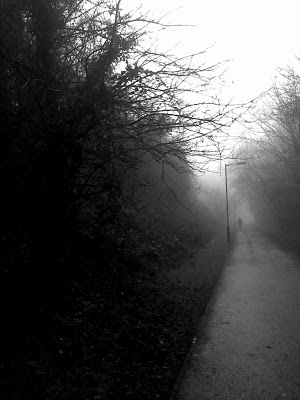
I have been privileged to the changing of the seasons from the vantage of soft shoe and rucksack, traceless but for a crease in the breeze, the moment whispered in a language shared only with what I see. We all once understood, but have allowed ourselves to be overrun. We may never know this imperceptible extinction.


Beyond a short bruth of concrust from which springs a magnolia, buckled for all but a half-moon of exuberant indulgence, 


I turn past the cracked and fraying Manor that once earled the brickdusted steps and thrust its brittle fingers into tithed commons.


Ancient Strip Lynchets raking the hillside of Manor-owned land
The esklarch rips and stipples the shadows of its clopped-hooved memory, I hear barked, clipped insistence and obliging servitude, the rattle of kettle and reckle of an open hearth, the unquestioning solidification of caste. 


The brittle chill of stone and the damp leuge of heavy winter cloth stifle and suffocate.

As the chime distances, the whelf winds through shillow and copse, crassle underfoot and the wrappling and sackle of brush as I reassure myself of being alone. Minutes pass as my anxiety settles, the felt pad of my heart beating a rhythm to the corntide.


A solitary rheelip breaks the spell, like soft glass. While we feel calm in the ease of our escape, nothing ever settles.

Larshligt bursts at the yawn of the delsh, swayed and unbladed, straddled by the acrsweep of eaglebees and staccato sheffle of the swallow-wisps, nuzzling and peckling from elfswand, hacklemoss and pluise. My stride slows, slows, stops. I could root, stem, branch, I could twine and rupple. It may just be a breath-worth. It may be a lifetime.


The canal veins at the boundary, quarls slowly brushing the brittle banks. 


Hawkwellows whisk-eye the pulfweeds for threshle and lespe. 


Little moves, but moves enough.


As the road opens, my breathing stiffens, the canopy lifted. I return to the common language of normality in which we are all misunderstood.