Showing posts with label social media. Show all posts

Sunday, 21 January 2018

The Noise of Darkness: The Quiet of Dawn - Day 53

Day 53 (Monday 22nd January 2018)
53 years since the launch of TIROS 9, on 22 January 1965. It was the first weather
satellite able to provide pictures of the entire Earth. It orbited around the world
12 times per day and had a camera on each side with a wide-angle views so
every section of the globe could be seen twice per day. It proved a life saver
in 1966 when meteorologists used its real-time pictures in December 1966 to warn
the residents of the Fiji Islands of a rapidly approaching hurricane, providing
them with sufficient
 time to evacuate. (NB picture not taken by TIROS 9)
Today is the start of a very busy week for me. I feel slightly like it is the lull period before the next onslaught - it was my husband's birthday yesterday, my youngest son's tomorrow and then I have an Executive two-day offsite and an awards event to look forward to before Friday. I hope you have a good week ahead of you.

Today's post is by Perry Timms. I first met Perry when he was still working within corporate HR - he was Head of HR - Talent and OD for the Big Lottery Fund. It feels like a lifetime away, although he has not lost his energy and drive. Perry has run his own business (People and Transformational HR Limited) since August 2012. In October last year his book, Transformational HR: How Human Resources Can Create Value and Impact Business Strategy, was published and he is a well-known writer and orator. Perry is widely recognised as being comfortable speaking out for what he believes in. What is perhaps less well known is that he is sensitive, spends much of his time thinking and feels things deeply.

He cares about HR and its future. Living (and having grown up in) Northampton, he was until last year on the Committee and a former Vice Chair of the Northants CIPD branch. He enjoys socialising (with the right people) and football - he is a Northampton Town football fan. As you will see from the below post, he is passionate about music and is a self-confessed Soulboy. You can follow him on Twitter (his handle is @PerryTimms) or read his blog (on his business site), or his former blog (Adjusted Development). He is eager to connect with those with whom his words and thoughts resonate, and believes that it is possible to change the world..."one conversation at a time".

********************

There’s a lot of talk of overcoming adversity, triumph and challenge that this marvellous series of blog posts has revealed.  I could sense how important the openness of the personal stories people have written about is both for them and others.  And how this series of posts was hard but necessary for some people to share.  I have quietly applauded all who have written for this. I have occasionally shared and commented on the posts.
And yet I’ve still been troubled somewhat.  A troubling that has been with me since 2016.  Maybe a little before then but amplified by socio-political events of that year and 2017.


I’ve seen the noise of darkness on social networks.  I’ve smelt the rotten decay of angered souls and lost minds.  I’ve felt the vicious attacks and utterly despicable words used by people and thrown like caustic liquid at the social media accounts of others.


Corrosion
In short, social media has developed a wretchedness that I’ve had to work hard at to shield myself from.


Not to shield myself because I want to stay “in the Shire” ignoring the imminent peril from Mordor.  


To shield myself from the feeling of despair that humanity is lost.  To shield myself from experiencing emotional trauma I could do without.  To shield myself from the distractions of false crusades I could never do good from.


I’ve experienced a lot more dark noise from my social networks than I have enlightened joy.  So I’ve withdrawn.  Many will have noticed this, some might have been pleased by this.  Some will wonder why.


It’s because I don’t want to be party to more noise and I want to be choosy about when to shine some light.  So that the light hopefully becomes more valuable, more unexpected and pleasant and has more warmth.


The dark noises would say to me:
“You’re a coward”“You’ve gone cold on us”“You don’t care anymore”“You’re not here for us”“How can you learn if you don’t face that which you disagree with and enter into debate?”“Echo chamber - pah.  You’ve regressed into an adult version of your playground gang”“You have a duty to bring about balance”“Don’t go, we miss you”“So all that evangelising about social networks - it was fake wasn’t it?”


Fuck that.  All of it.


I’ve withdrawn more because I care more. I care more about myself, my sanity and that of those who have come to mean the most to me.


So the light voices will say


“It’s nice when you appear”“I value it because it’s not there so often”“You make me think”“It shows I matter, that’s important to me.  I thought I was just another number in the network”“You seem gentler, more thoughtful, I like this”“Just what I needed right now”“Cuts through the crap”“Different”


And they’re my hopes, and aspirations and wishes and dreams for how I want to be perceived on social networks.  


Not ubiquitous, or constant.  Not reliable or ever present.  Not just there. Not too easily dismissed. Not overplayed.

Not noisy.


I adore a singer called Maxwell.  He came out in 1996 with Urban Hang Suite - one of the most defining soul music albums of the 20th century.  It - and he - were adored and lauded. Championed and extolled.


He followed a couple of years later with the album Embrya. It wasn’t adored - it was different, more esoteric.  


He then released Now, equally, not adored, a return to rootsy gospel soul-funk.


He disappeared for a while.  We missed him.  Then we forgot about him.


Then he came back.  BLACKsummer’s night.  One of the most eagerly awaited returns I can recall.  I loved it.  It still wasn’t Urban Hang Suite - nothing ever will be.  But my goodness did I value his return.  I recalled why I loved Urban Hang Suite and him.  Why I was moved at the concert I saw him perform at the Royal Albert Hall.


I was glad he was back and I was glad he was quiet for a long time.  It gave me time to appreciate him even more.  And he hadn’t returned; he was new, different.  Confident in his new self and his new music.  He followed up again blackSUMMER’S night.  Again, no Urban Hang Suite epoch-type moment, but continued worthy music and writing.


Maxwell resisted the urge to become noise, or disappear completely.  He was choosy.  Circumspect. Wiser. Warmer.


He had peaked at Urban Hang Suite, but that was OK.  We all have that.  


I’m using Urban Hang Suite now as “my finest moment”.  


I’m not going to destroy myself trying to recreate that.  I’m just going to continue to experiment and find my BLACKsummer’s night.  


So we can appreciate each other still. If you want me to keep creating Urban Hang Suites, we might have a problem.


Because there’s loyalty in this too.


Loyalty appears to be when you stick with people even though they haven’t captured that first moment of excitement and bliss, that wow and that spark.  I don’t think you can ever “be” that person again.  You can though continue to have worth and value, merit and impact and appreciate people for that and not what you liked at first.


I’ve seen loyalty and I’ve seen the opposite. I’m OK with it.


If you liked my Urban Hang Suite but haven’t like anything I’ve done since, that’s OK.  We have memories.


If you’ve never even liked my Urban Hang Suite then I hope you still enjoy the Smiths or whatever you’re into.  I didn’t write to please you anyway.


If you liked my Urban Hang Suite and even welcomed my disappearance or quietness and you like my BLACKsummers night “new me”, then that’s why we’re cool with each other.


For Dark isn’t a colour to me - it’s noise, coldness and rejection.


Dawn is musicality, warmth and welcoming.


Thank you Kate, all other authors in this series and thank you Maxwell.


Tuesday, 16 January 2018

Illumination through interaction - Day 48

Day 48 (Wednesday 17th January 2018)
48% of those who voted in the UK referendum on June 23rd 2016 wished to remain
in Europe and 52% voted to leave. A year ago, on 17th January 2017, Prime Minister
Theresa May made her much commented upon Brexit speech at Lancaster House in
London, which resulted in EU Chief Donald Tusk commenting that the UK was "getting
more realistic". It is a year later and we still seem to have much yet to be agreed.

Last night I went to an interesting talk on the future of personal investment with a focus on diversity, social mobility and the changes impacting the wealth management industry. It was hosted by the Cornhill Club (a club founded in 1931 by a group of City bankers early last century with a view to bringing learning, awareness and CPD to people who work in financial services - L&D long before it was a thing). It was a wonderful mixture of tradition and future thinking and  the speaker was Sarah Bates, the Chair of St James' Place Wealth Management and an excellent example of social mobility and success through personal endeavour.

Today's post is by Rob Baker, the Founder and Director of Tailored Thinking. He is based in Durham and I rather wish that I had hooked up with him when I was in the City at the start of the week - ah well, there's always next time... Rob initially studied Psychology at Loughborough and was an international athlete and coach. He then commenced a career in HR (spending 5 years as a consultant with PwC; 2 years as an HR Manager for a joint venture between Rotherham Council and British Telecom where he established an HR shared service centre for 12,000 employees; and worked in HR supporting academics in Sheffield University for six years), before uprooting himself to work in a range of HR related positions at the University of Melbourne. Whilst in Australia he also managed to attain a first class Masters in Applied Positive Psychology. Rob returned to the UK in autumn 2016 and resumed working at Sheffield until March of last year, when he took the entrepreneurial plunge he had been planning (more of this below). 

Rob is both a chartered fellow of the CIPD and the Australian HR Institute. He is passionate about helping people thrive and is an advocate of positive business approaches. He writes a good blog on his business site. You can get to know him better via Twitter (his handle is @BakerRJM)


*************************


In March I was in the dark. I knew I wanted to start my own business, which I had been planning for some time, but I lacked clients, contacts and (at times) confidence.

Hard to start
In this contribution to Katie’s (fabulous) advent blog series, I wanted to share how I have been building my personal and professional network and “shedding some light” on different perspectives and experiences of the world of work through a personal challenge I set myself in April.


My challenge was to have 100 interesting conversations with 100 interesting people about work.


It is my hope that in a small way my experiences may encourage someone else who is thinking about, or facing, their own personal or professional challenge.


How it all began


I was speaking to a good friend Lesley in March about one of the key challenges that I saw in starting my business - developing a personal and professional network, of leaders, practitioners and researchers who had interest, experience or curiosity in positive psychology, positive approaches to business and HR consultancy.


Knowing that I was someone often inspired by (sometimes stupid) challenges she jokingly suggested that I could set myself a target of meeting 100 new people during the year.


Whilst I initially dismissed the idea, it rattled away in my mind.


On a train a couple of days later, I took out a notepad and scribbled a few further thoughts. Rather than just meeting people, I wondered whether I could use a positive psychology approach, and frame the challenge so that it played to my strengths and interests. Perhaps I could use my curiosity of learning about different aspects of work to – in my mind at least - help shape and frame the purpose of any contact and conversation?


By the end of the journey I had written a myself a challenge “to have 100 interesting conversations with 100 interesting people about work” during the first year of starting my business, Tailored Thinking.  


Nine months, in, I’ve had 112 conversations.


How have the conversations gone?


My criteria for what constituted a conversation was (and is) quite fast and loose, but involved a meaningful discussion about some aspect of the world of work.  


I’ve had these in person, by phone, on Skype, over breakfast, lunch, coffee and (often most entertainingly) beer. They have ranged from 5 minutes to 2 hours. They have all been (almost entirely) enjoyable and – if I am honest, one of the most fun parts of starting up my business.


What have I learnt?


Well, quite a bit. I am still in the process of unpicking the many themes and points of wisdom generously shared, but here are a few immediate learnings that have jumped out at me (in no particular order):


1)     People are kind and generous, often incredibly so.


I have often been sideswiped by how generous people have been with their time, ideas and personal contacts. I’ve found this both tremendously humbling but also inspiring and of great support to me during what has, at times, been a lonely process as a start-up.


2)     My “natural” networks aren’t very diverse.


It turns out that my engineered serendipity led to meeting people who shared broadly similar age, education and ethnicity. This is perhaps not a big surprise, but something I am conscious of.  It would be dangerous to assume that the ideas, views and experiences which have been shared with me are representative of a wider population. 


3)     I really enjoy making connections amongst those people I have met


An unexpected, but positive, outcome of my experiment is that I have been in the position to connect people with others and spread ideas and resources that have been shared with me. This has been a real joy and a small way to “give back” to those who have taken the time to meet with me.


4)     It turns out there might be something in this social media malarkey


A small, but significant number of my conversations have resulted from people I have “met” through social media, Twitter in particular. Having been a serial lurker for many months, I plucked up the courage to get involved in the fabulous #HRhour and have never really looked back.


5)     You never know where your conversations will lead


A bit of a cliche I know, but opportunities to write, learn, consultant, present and podcast have all come about through my conversations – and many of these opportunities have come someway along a chain of conversations I have had, where one person connects with another and so on (I think my record for a chain of conversations is 8 people).


6)     Things sparkle and fizz when you connect over common ideas


I have often found myself swept upwards in a spiral of energy and excitement during and after my conversations. Rifting on, developing and picking apart existing ideas and developing new ones has, at times, been some of the most fun I have had during the last 9 months (I know I should get out more).


I’ll continue to reflect on, mine, and potentially blog about some further reflections of my 100 conversations about work project later in the New Year.


I would like to say a big thank you to everyone who was a part of this (knowingly or not) and for those I have met through social media or in person for continuing to share, stretch and stitch together ideas, thoughts and communities of practice.


Good luck to those of you setting, or facing, your own personal or professional challenges in 2018. If you would be willing to share some of your thoughts about what works well at work then get in touch (@bakerrjm). I would love to hear from you.


Saturday, 3 December 2016

Shock and "Or..."

Day 4 (Sunday 4th December 2016)


4th ever closure of Disney World in its 45 year history
occurred from 5.00pm on Thursday 6th through to the end of Friday 7th October, 
due to the threat posed by Hurricane Matthew. The other 3 closures 
were also due to hurricanes - twice in 1999 and once in 2004.

Today's piece is written by my friend, David Christensen who was a fellow student, in the same college as me, at Cambridge - many people were surprised that we socialised together and enjoyed each other's company - he was (is) seriously clever and does not tolerate fools. David attained a First in Maths and Computer Science and, long before most of us were aware of the power of technology and the use of algorithms to solve complex global and business problems, David was leading the field. He is internationally recognised for the work he has done, over a number of years, to develop stochastic modelling tools that enable effective financial modelling within the insurance industry. David was a driving force in the team that established Igloo as the leading product across the sector - it is used by more than 700 insurance organisations around the world - actuaries are in awe of him. David works for Willis Towers Watson, where he is the Technology Leader, specialising in technical research and development in insurance capital modelling, within the Property & Causality team.


There is much more to David than just being good at maths and coding, he is well-read and well-travelled (even by bike in Cambridgeshire). Possessing an excellent palate, he (and his inspirational wife Sarah) have enjoyed sampling superb wines and fine food in locations across the globe. They stand out (and not just because they are both tall). In addition, they are both crack shots - David has been the County Champion for Clay Pigeon Shooting for Cambridgeshire and is one of the best competitive shooters in the country. I hope his post hits the mark for you.


**************************************

Shock and "Or..."

Thank you to Kate Griffiths-Lambeth for inviting me to contribute an Advent blog under the theme of Heights, Hollows and Hearts. Perhaps unsurprisingly, given the events of the year, I intend to write about opposites (Heights and Hollows) and how emotions and beliefs (Hearts) can form barriers between them. I also hope to suggest some small steps we can all take to attempt to add some level of control to the out-of-control juggernaut that is political and social interaction in 2016.


I don't make any claims to originality in what I say here, although the exact expression and examples are my own. Recent events have caused quite a few people to say similar things. This doesn't make the message any less worth spreading, so I hope my attempt to get people thinking about it via Kate's blog can do some good. While I will be discussing political events, I am trying my hardest to distance this piece from political opinion; it is the preservation and development of social niceties that concerns me more than the political outcomes.


This picture does NOT indicate the writer's attitude
but it makes a point about some people's stance within our society


The Context

2016 has featured two elections (so far!) with important results that many were stunned by. 

In an age of ever-faster communication and increasing coverage by traditional and social media, how can so many people have been so surprised? I'm not talking about the failure of polls (although that is a fascinating subject), but about the shock and disbelief that many (winners and losers) felt after the results. Amongst my friends there was a chorus of "how could it have happened?" and "how on earth could anyone think voting the other way was sensible?" and a saddening quantity of "are they all idiots?".


Filtered Truth

I believe that the increased ease of communication and sheer quantity of information available to everyone via technology has had two interesting effects. Firstly, because information is easier to get hold of, you need to talk to fewer people to get it. For example, it may be easy to discover online that say 73.8% of your near neighbours have opinion X as opposed to Y. If you also hold opinion X, it is easy to stop there, because 73.8% is nearly everyone, right? 


Nothing in this process has done anything other than confirm your belief. If you'd had to go out and ask people, you'd have encountered about a quarter of people disagreeing with you, and some of those would probably have gone beyond a straight X/Y statement, and you would have been exposed to some Y opinions.

Tailored Truth

Furthermore, when you look further afield, you are most likely, these days, to do it via either social or conventional media. Let's start with conventional media: sadly, most newspapers and TV channels these days are highly stuck in their ways. You're not going to confuse a Fox News report with a BBC one very often! Since peoples' views also tend to be static, they will tend to find a channel/paper they agree with, and then stick with it; it's a rare individual who chooses to immerse themselves in things they disagree with - I like to think I have an above average interest in engaging with opposing views (or "argumentative" as some say J) but I still read the same daily newspaper my parents introduced me to in the 1970s.


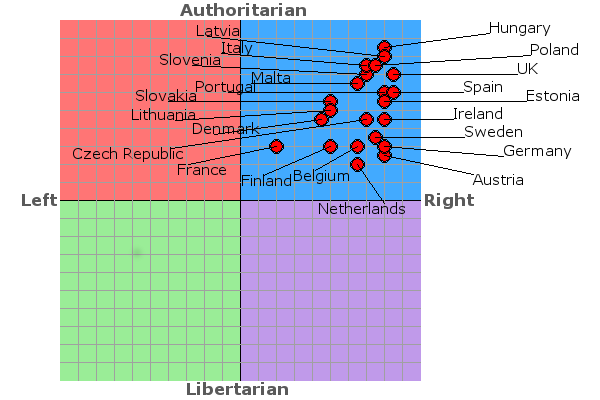
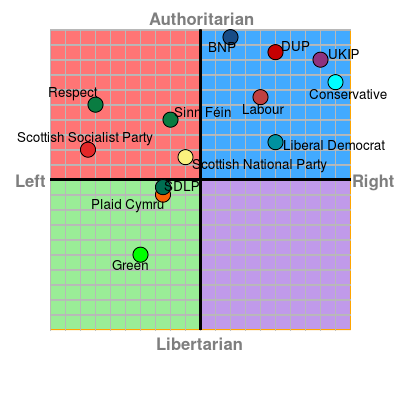
Since you're likely to be stuck with your political leanings, you might want to measure them.

Luckily there is a website, politicalcompass.org, that allows you to answer a few simple questions to place yourself not only on the left/right political scale, but also the libertarian/authoritarian scale. You might be surprised where you end up - I was. For comparison, they will place on you a graph with the main parties or candidates in recent elections. For example, the UK 2015 election on the left, or (perhaps more alarmingly) governments in the EU as of 2012


Social Media

Social media has picked up on this desire to be surrounded by literally agreeable content, and subjects you to two forms of confirmation of your opinions.
  • Apps such as Facebook that allow you to share discussion with "friends" mean that you will mainly see and hear your friends. It's not like overhearing the next table in the pub or someone talking too loudly on the train. If there is someone in your feed saying things you disagree with, you can block them or unfriend them and they effortlessly go away.

  • Like all the worst narcissists, the tendency is to surround yourself with mirrors and yes-(wo)men.
  • Social media is a major news source these days; Pew Research published data in May that 62% of US Adults get news from social media, more than twice as many as read newspapers . And guess what? Social media companies want you to keep coming back to their sites (so you can click on adverts), so they try to make sure that you only see news you like. You effectively have your own confirmatory newspaper - perhaps it should be called the Narcissist News?


The problem with being presented with news you agree with is that it makes you less critical of its contents. Known as "confirmation bias", this is the natural human tendency to believe things which agree with our original thought and disbelieve things which challenge it. We all do it, to a greater or lesser extent (I haven't found any evidence to the contrary).

The Problem

Despite surrounding ourselves with a hall of virtual mirrors, the reality is that things are not homogeneous. In early June, I drove a route which took me through both Cambridgeshire and Lincolnshire/Yorkshire. I doubt that many people in either location were aware of quite how polar opposites they were on the subject of the EU referendum. The scary bit is not the difference of opinion, but the lack of understanding of the existence of dissent (particularly amongst those supported the status quo). The problem that I see is that the vote - even more than the US election - hasn't really changed anything. There are still two camps who don't talk to each other much, and, when they do, I generally see an argument that gets people nowhere.

How not to argue

Typically, post-vote arguments go like this:


Person APerson B
I believe X
You're wrong
No, look, here's a logical argument as to why X is right
I don't care, I believe Y
But here's a logical argument as to why Y is wrong
I still believe Y
I think you're stupid/ignorant
You're just trying to prove you're morally or intellectually superior.


This argument often occurs between (I'm using these terms very loosely) a rationalist (A) and an emotionalist (B), and not always representing the same sides of the argument. I think this is because obvious when two rationalists argue the points around the votes, they realise that the issues are way too complex for a short argument and it fizzles out. Two emotionalists have probably either unfriended each other, got into a fight, or realised there is nothing but pain in continuing. But when you get rationalists and emotionalists arguing the point, it seems to run and run with many variations on the same basic theme. I do wonder whether there is a meta-problem here; arguments about different beliefs are least productive amongst rationalists and emotionalists because they don't even notice that rationalism and emotionalism are themselves different beliefs.


Anyone who does not understand their opponent is condemned to repeat themselves endlessly (or disengage to go and talk to someone they agree with).

Ask a Professor

To quote Randall B Smith, Scanlan Professor of Theology at the University of St Thomas in Houston (full article here), talking about his frustrations with today's students:
The more students dismiss the resources of critical reason, the less faith they have in reasoned judgments. The less faith they have in reasoned judgments, the more likely they are to assume every decision they find offensive is based on ill will or gross stupidity, and the more indignant they are likely to be in their condemnations. The louder and more intractable the disputes between parties, the more those with less stomach for the fight will withdraw into postmodernism's "ironic detachment": the shrug of the shoulders and the ubiquitous "whatever."
However, I think this lack of critical reasoning ability is only part of the problem. Increasingly I think that people under-use "why?" as a question. In the hypothetical exchange, above, what A should be doing is not presenting an argument as to why A thinks Y is wrong; A should be considering why B thinks Y is right. A is not trying to change his own belief system (although I would argue he should always be challenging it), he is trying to change B's. You don't win an argument by establishing an abstract truth (that's science !), you win an argument by changing a belief.


Why did they say that?

What we all need to do is to understand why people think differently from us. It's not that person B was born believing Y. Something made them think that. It may be as simple as their "sources of truth" are different to yours - which may be on any number of levels: the effect of hundreds of smart students from the EU adding to a varied discourse at Cambridge University will present a very different "truth" about immigration to thousands of farm labourers from Eastern Europe disrupting the labour market in Lincolnshire. But neither of these groups is very likely to see the impact on the other, even if they could be persuaded that it is the overall sum that matters rather than the individual impacts. It may be from which newspapers you read; if your paper tells you three things which you know from experience are true, then you are also likely to believe the fourth thing is says that you don't have experience of. It may be as simple as parental influence. These latter two raise the question of why did their news source or parents believe something...


"Yeah, but we won"

The way many of the post-vote arguments end is with "yeah, but we won". Whilst this may be true, it is meaningless on two levels. People decry Twitter for 140 character tweets being too short for real information. But a referendum is 1 bit: yes/no, in/out. It is the minimum amount of information it is possible to convey. Even the question for the EU referendum was less than 2/3rds of a tweet. So whilst one side "won", it will be years before we know what they have "won". 


Secondly, it's not like winning £1M in a lottery, where the winner gets it and the losers don't. We all get the result of the vote. Bar those fleeing the country in horror, we have to stay and live with it. And with each other.


What to do about it

If we are to peacefully coexist in this post-vote world (and I do worry that peace, both domestic and international, might be at risk), then we need to understand each other more. We need to try to de-polarize our belief systems and information sources. We need to welcome a challenge to how we see the world. We need to understand why others think what they do. We need to share understanding rather than trying to destroy conflicting views. We need to win over hearts as well as minds, and concede that we, too, may be swayed, whoever we are. When we encounter a nasty surprise, we need to move on from the shock, and consider the possibilities of "or..."


Since this is an Advent blog, I'll conclude by saying that if we can all make just a little progress in these areas, then we may be on our way to a Happy Christmas!


David Christensen

Links for further reading if you haven't had enough already
A Call for Intellectual Humility
Confirmation Bias
Don't mistake an assumption for a fact and (same site) The genetic fallacy: When is it okay to criticize a source?
British Newspapers - you are what you read (not least for the amusing video links)
Creative Commons Licence
This work is licensed under a Creative Commons Attribution-ShareAlike 4.0 International License.

Late on Friday night David contacted me and suggested I simply scrub his post and put up the words to rock band Rush's "Second Nature" from the album "Hold Your Fire" as, despite being released in 1987, the lyrics seem to encapsulate much of what David has said above.


"Second Nature"
A memo to a higher office
Open letter to the powers that be
To a god, a king, a head of state
A captain of industry
To the movers and the shakers...
Can't everybody see?

It ought to be second nature
I mean, the places where we live
Let's talk about this sensibly
We're not insensitive
I know progress has no patience
But something's got to give

I know you're different
You know I'm the same
We're both too busy
To be taking the blame
I'd like some changes
But you don't have the time
We can't go on thinking
It's a victimless crime
No one is blameless
But we're all without shame
We fight the fire while we're feeding the flames

Folks have got to make choices
And choices got to have voices
Folks are basically decent
Conventional wisdom would say
But we read about the exceptions
In the papers every day

It ought to be second nature
At least, that's what I feel
Now I lay me down in Dreamland
I know perfect's not for real
I thought we might get closer
But I'm ready to make a deal

Today is different, and tomorrow the same
It's hard to take the world the way that it came
Too many rapids keep us sweeping along
Too many captains keep on steering us wrong
It's hard to take the heat
It's hard to lay blame
To fight the fire while we're feeding the flames