Showing posts with label education. Show all posts

Monday, 10 December 2018

I know pain - you can’t hurt me; I’ve seen defeat - you can’t stop me - Day 11

Tuesday 11th December 2018

11 was the number of the Apollo spaceflight that landed the first two people
on the moon on the 20th July 1969. To this day there are regular allegations

that the whole mission was/is a hoax with evidence such as a 'flapping flag'
and a star-free sky being used to substantiate these claims.
Today we have a very personal blog, written from the heart, by Gary Cookson. He is an HR, OD and L&D expert who runs a consultancy business, EPIC HR. Gary is a key member of the HR community and I am proud to call him my friend.

However, the most important thing in Gary's life is his family - his adored wife and four wonderful children. His eyes light up whenever he talks about them. 

Gary is a caring, brave and wonderful man. He took note of my plea for interested parties who might want to run the Advent Blog series to contact me. I really do believe that the series (and you the readers) would benefit from a fresh pair of eyes and a new focus. 

Let me tell you a bit more about Gary: his business, EPIC, helps people to Evolve, Perform, Improve and Compete. Gary himself is physically competitive - a keen sportsman, he is a regular participant in triathlons and has managed some representative sports teams. Prior to running his own business Gary worked in HR in various sectors including Housing, Education, Not-for-Profit and Public (for the DBS). Prior to HR he qualified as a secondary school teacher (teaching History). He has a way with words - he blogs on the EPIC site and you can also catch his wisdom on Twitter (his handle is @Gary_Cookson) as well as hearing him at various conferences and events throughout the year.

I a delighted that he has come forward, as I can think of few who would match him in running this series. I am quite looking forward to being a contributor...

************************


The theme for this year’s advent blog series is Heartaches, hopes and high fives. The announcement of the theme prompted some deep reflection on my part - as per usual, my year has contained all of these in good measure, and, as usual, my blog is a personal account of this.

I’ll take them in theme order even though as I’ve planned this blog I’ve thought about things in chronological order. The quote which makes up the title of this blog is one of my favourites and comes from the ex WWE wrestler Tazz, but somehow seems appropriate here.


Heartaches

I’ve had a few.

My mum, who last year I said was having treatment for cancer and who I was estranged from, went into remission for part of the year but the cancer returned and she has resumed treatment. Perhaps the only good thing to have come from this is that it has helped us begin to repair our relationship.

My brother's partner, only in her early 30s, is also undergoing similar treatment and it seems out of proportion to be affecting our family like this.

My youngest son, at the time only 5 months old, was rushed into hospital for 3 days with suspected meningitis and whilst we were glad it ended up not being, it was still a serious virus and a very worrying time for us. 


My eldest daughter, now 13, decided this year that she no longer wished to live with me half the week as she had done since aged 3, and has gone full time to her mum's. Neither she nor we have any real explanation for this, but it shows no sign of changing and I’m heartbroken that someone to whom I was so close, for whom I was her hero and prince, who I loved beyond measure, can suddenly decide everything has changed for no apparent reason. I barely see or speak to her now and it’s left a massive gap in my life and heart. Worse is the effect this has on her two younger siblings, one of whom cries every time the elder daughter comes and goes, and wants nothing more than to play with her, and the younger of whom is growing up not knowing his eldest sister.


And finally I’m reminded of my own physical weaknesses. The male members of my family have a history of heart disease that strikes in their 40s. Knowing this, I’ve kept myself more fit than any other family member for a decade and had thought I might buck the trend, but there have been signs in the last year that my body thinks differently and I’m having tests to check what is going on with my heart, which aches.


Hopes

I obviously remain hopeful that all the heartaches will resolve themselves but in addition to these I have the following specific hopes.

That my eldest son passes his driving test and does well in his mock A levels, giving him a clear path to University.


That my two youngest children make a successful transition into full time school and nursery respectively.

That my wife makes a successful return to work after her maternity leave ends. 

And I hope my business, EPIC, continues to grow and develop in its second year. Even though I’ve done well in year one, I would like to be able to secure more income streams and add more value to clients and be able to relax more. 

High fives

Thankfully there have been lots of these. In no particular order:

My business was set up and has exceeded my wildest dreams in terms of its success. I did it at the right time and for the right reason and that fuel has helped me do things I didn’t think possible.


My eldest son got some impressive GCSE results and even bettered my own tally. He also began to realise his potential in our main sport and began to surpass my own levels of achievement and ability (even though I had a great year myself).

I’ve seen my eldest daughter develop some real and unexpected artistic talent, previously no one in the family has possessed this.

And I’ve seen my fourth child born and grow so well, with the high five going to my wife who managed a home birth with no pain relief!


Conclusions

Apologies for the very personal blog but it seemed appropriate for the theme. Often this year I have focused on the heartaches as these tend to dominate one's thinking and emotions, but having a theme like this reminds me, and all of us, that life doles out heartaches, hopes and high fives in roughly equal measure, not necessarily equally in one given year but certainly across a lifetime.


One can dwell on any of these areas but remember - they’re all there and more will come in each category too.

If, like me, you’ve not had a perfect year, then maybe, like me you’ve had an average year.

And that’s neither good or bad. It’s a sign that you’re living your life.

Doing your best.


When things go well, celebrate the successes, but when things go wrong, learn from the fails and stresses.

You’re going to have more of both. Get used to it. It’s called living.

Gary


Friday, 31 January 2014

All Will Be Revealed

Having enjoyed the test of writing to others’ themes earlier this month, I requested three fresh words and couldn’t help but smile when a relatively new contact, Tony Jackson, a member of the HR community, who writes an excellent blog, promptly gave me “Revelation”.  At the start of January the ever inspiring and occasionally provocative Simon Heath had presented me with “Antediluvian”.  I pondered whether I should write a piece that follows on from my former blog, stretching my thoughts from the times before the Great Flood (as defined in the Book of Genesis in The Bible) to the Apocalypse, as per the end of the New Testament in the Book of Revelation.  I was tempted to eulogise about angels and demons (perhaps a topic for another post) or to dive down an intellectual rabbit hole - there is a scholastic tome, Revelation, Imperial Cults and the Apocalypse of John by Steven J. Friesen, which considers the impact that living in a time where imperial leaders, specifically Caesar Augustus, were worshiped as gods must have had on the Book of Revelation, with Nero perhaps being the inspiration for the Beast of the Sea.  It could have been interesting to consider eschatology and draw a comparison between typical, patriarchal organisations (with command and control and little contemplation of the emergence of a new order or an end to the regime) and more collaborative institutions, exploring the impact of the development of social media that is inspiring rebellious talk, encouraging greater creativity and the sharing of thoughts.


Durer: The Revelation of St John,
the Sea Monster and the Beast with the Lambs Horn 1497

But then two other words arrived: “Congruence” from the estimable Ian Pettigrew.  Ian is a coach and expert on leadership and resilience, he is also one of the nicest of men I know, with the ability to see the spark in others and to make them shine; and “Holistic” from the multi-talented Jon Bartlett, whom I am honoured to call friend.  Jon is also a leading coach with an interest in resilience.  He is an excellent photographer, a keen cyclist and he cares deeply about people and their ability to escape limiting beliefs and achieve their potential.  Like his proffered word, Jon considers and works with the intimate interconnections within a person’s life, those that make them the whole being they are, and which influence their thoughts and behaviour.  There is a connection between these words.  Revelations are often a form of confession that enable you to appreciate the bigger picture and to understand the way in which things fit together.  The author Jeanette Winterson makes the following comment in her autobiography, Why Be Happy When You Could Be Normal?
“Most kids grow up leaving something out for Santa at Christmas time when he comes down the chimney.  I used to make presents for the Four Horsemen of the Apocalypse.”


Four Horsemen of the Apocalypse, Victor Vasnetsov 1887
 
This statement tells you much about her home life as a child, reading between the lines it must have been one of religious zealotry, with a focus on the imminent destruction of the world and the salvation of the righteous, it clearly had a profound impact on her.  As a mother, I am mindful of the impression I am making on my own children (and I have spent much time considering how my experiences of being parented have moulded me into who I am and how I treat others).  Parenting is tough and demanding and there should be no finger of blame – everyone gets it wrong at some stage; there is no universal approach that suits all.  However, I do believe that adults have to be responsible and try to lead by example.  People at any age need to feel cherished and children are wonderful sponges, eager to absorb information, to copy and to learn.


It is the congruence of experience and understanding that leads to learning (this approach is espoused in the theories of the humanist psychologist Carl Rogers who believed that “individuals have within themselves vast resources for self-understanding and for altering self-concepts, basic attitudes and self-directed behaviour”).  It concerns me that we make so little time for our children to help them develop and fulfil their potential.  The western work culture, which usually demands long hours from the workforce and is one where many employees do not take all of their allocated holiday, often deprives both children and their parents of valuable time together.  People usually learn best from other people, but this requires meaningful time with those who care and who can be genuinely supportive.  Every day I meet adults damaged by bruising experiences and lasting misconceptions forged during their upbringing.

Vintage postcard


Of equal concern is the way in which our society is preparing our children for the future.  We have a strong focus on academic achievements.  However, the education system we have in place has not changed since the last century and nor have the “core” subjects.  The UK has slipped down the global educational standards league tables since 2006 (from 24th to 28th for Maths, 17th to 23rd for Reading and 14th to 21st for Science), although the position has remained static for the past couple of years.  Education continues to be a matter for concern as we contemplate our ability to compete in the global arena. There is a proposal now to extend UK state funded schooling to 45 hour weeks, with shorter holiday periods (cut from 13 weeks to 7), and for a 9 hour school day filled with a broader range of learning than the current focus on academic and vocational exams.  This is intended to boost education standards, reduce youth crime and antisocial behaviour and reduce childcare costs.  But what are the costs of the change? 

  • Will we really be equipping our next generations with the skills that they will need? 
  • Are employers working with the educational establishments to make it clear what proficiencies and attributes will help students thrive once they enter the workplace? 
  • Have we given much thought to what the world will be like and hence the talents they will need? 

I think there is much we can do to enhance the manner in which we prepare the next generations for their turn to care-take our planet.  Traditionally we have focused on academic and vocational subjects, but “soft” and "creative" skills have their place – as the use of technology increases we need to ensure people are effective at communicating and comprehending others’ points of view.  Increasingly the world of work involves collaboration and for that you need to understand other parties’ needs and opinions.  I believe we should encourage children to think and find out more for themselves, rather than learning prescribed answers and dates by rote – information can now be sourced with ease, it is those who can apply knowledge in a productive way who will be most useful to society.  We must become less censorious and encourage children, liberating and encouraging them into wishing to seek knowledge.  For them to succeed, we must become more tolerant of failure, with mistakes come learning and potentially positive outcomes (James Dyson failed over 5,000 times before be created his innovative vacuum cleaner).  Nelson Mandela said:
“There can be no keener revelation of a society’s soul than the way it treats its children.”

Our society’s soul is exposed in our approach towards families, employment practices, educational establishments and the workplace.

Much can be uncovered when you make the effort to observe and to try to understand.  True revelation requires you to hear the music and not just read the notes transcribed on a page.  This is where having a holistic mind-set comes in - things are often not quite as they seem or there is more to a situation than meets the eye. I love the work by Ecuadorian graphic designer Javier Perez, who turns daily objects into clever minimalistic illustrations.  The success of his work depends on the convergence of unconnected, different objects to create a unified image (not dissimilar to the congruence of ideal self and actual self to form an effective whole):

by Javier Perez

It is important to look at the complete picture, rather than being distracted by a detail that is only a small constituent part.  If asked, few can say where they have seen this image before (many wonder if it is from an eighteenth century wall paper design):


 But almost everyone in the UK is familiar with one of these:


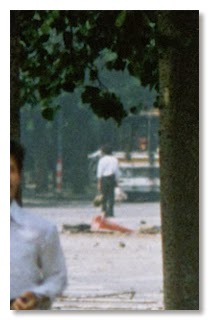
The hummingbird is seldom remembered.  In order to be successful (and not just at work), we need to pay attention to the details that when combined make up the whole.  By being aware of a complete scene or scenario and how it fits together you are better placed to make the right assumptions and decisions.  The photograph below was taken in China (given that today is the first day of the Chinese New Year, I will take this opportunity to wish you "Kung Hei Fat Choi" - may the Year of The Horse provide you with a wonderful ride).  The snapshot looks like an unremarkable photo of a tractor and loader, until you notice that there are tanks in the background.  However, the most remarkable aspect of this picture has probably escaped you...

NY Times, taken by Reuters correspondent Terril Jones


This is in fact the only photo that shows the famous man from the Tiananmen Square incident in 1989, he stood alone, confronting the tanks; you can see him to the left of the frame, calmly carrying what looks like shopping bags, as he walks towards the tanks (everyone else is running or riding away):
 

The importance of this picture was not appreciated until 2009, which is when it was published.  The man's identity is still unknown, but many people around the world are familiar with and acknowledge the importance of this picture:
The brave actions of one man have made a lasting impact on the world.  I doubt whether, at the time that he strode towards the tanks, he had any idea of the influence he would exert.  If these photographs had not been taken the event would have passed unnoticed.  Yet his courageous but small act has impacted the way that we all think.  When similar incidents occur (such as news footage of people standing defiant in Egypt or Nepal) our brains are triggered to recognise and respond in a familiar manner.  This can be a dangerous trait - it is all too easy to take the reflex path of thought and not explore the rationale for why things are happening.  This leads to congruence bias where, because you are convinced that your reasoning is correct, you fail to test your hypothesis.  As mentioned above, our world is changing fast and what was fit for purpose or the old regime may not be what we need now.

As is often said at New Year - "out with the old, in with the new". 


We must move with the times - think about the skills and capabilities both we (and our children who will be responsible after us) will need.  It is crucial that we don't let congruence bias prevent us from actually comprehending the world ahead.  We must strive to think holistically to gain a better insight.  If we work together, an auspicious future can be revealed (as opposed to suffering an Apocalypse now).