Showing posts with label culture. Show all posts

Thursday, 6 August 2015

Shake, Rattle and Roll

After our trouble-laden journey, it was bliss to arrive at the hotel in Antigua (a short drive from Guatemala City), have a shower, grab a bite to eat (our first black beans of the trip) and then exit out into the warm air to explore. 


Picturesque is an understatement for the town, Antigua, is the former capital of Guatemala, with cobbled streets, charming colonial architecture and an easy-going, cosmopolitan ambience. We followed the crowd down the grid of streets towards the main town squares, churches and cathedral.


Antigua is nestled in a broad highland valley with the surrounding slopes covered in pine trees and forest. Its apparent calm belies a turbulent past – both socio-politically and as a result of its location. 
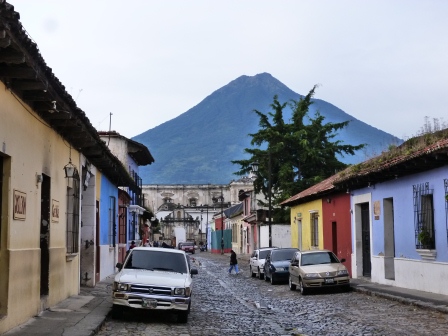


Huge cones of three volcanoes overshadow the town and they have played an active role in its history. Volcán de Agua destroyed the first Guatemalan capital and even now there are shattered remnants of once-stunning edifices destroyed by earthquakes, mud-slides and eruptions. Volcán de Fuego is still active today – snorting small puffs and plumes of gas and smoke into the sky, a constant reminder of the potentially devastating impact of Nature.


People have learned to live with the threat and the architecture reflects this – buildings are surprisingly squat 


with hard cores concealed within pillars to absorb shocks, buttresses and tapered arches to withstand quakes and resist collapse. 


(They remind me slightly of coping strategies used by people under repeated stress – relying on support from friends and becoming entrenched and immovable in the hope of remaining strong and undamaged). 


Our first stop was the church of La Merced – a fantastic example of Antiguan Baroque. Buttermilk yellow - with exquisite, fine white plasterwork decoration like the most elaborate of wedding cakes – some of the ornamentation exemplifying the need of the Spanish invaders to connect with the local community. For example the maize cob and cocoa pod (both sacred to the Maya) are shown under the Virgin Mary, above the doorway, on the glorious façade.


The church was constructed by the Mercedarians (the Order of Mercy was the first religious order to establish a monastery in Guatemala) – they must have been a stoic and determined group of men, as three temples or churches were constructed on the site, and each destroyed by quakes or lahars, before the current building. The first church, completed in 1583 was destroyed in an earthquake in 1749 and La Merced as we know it was completed in 1767. There was a wedding occurring at the time that we visited – with an elaborate banquet and decorations around the famous fountain and under the Mayan-style arches.


We were welcomed inside the church, but tiptoed around and tried not to disturb.


There is a famous figure of Jesus Nazarene, sculpted by Alonso de la Paz in 1650, with noticeably dark skin that appeals to the local community - it is paraded through the streets during Holy Week with thousands paying for the honour of sharing the burden.


I was interested to see the faux mosaic decorations on some of the pillars – these have been created out of small pieces of paper cut from magazines by prisoners.


The church helped sell similar artworks to the public, thereby raising funds to support convicts’ families – the pillar decorations were a gift to the church from the prisoners by way of saying “thank you”.


After La Merced we ambled down Antigua’s equivalent of Fifth Avenue, lined with boutiques selling jade jewellery, art galleries and a surprising number of western-style restaurants and cafes. We passed under the Santa Catalina Arch – inspired by the Corridoio Vasariano above the Ponte Vecchio in Florence, it enabled the nuns to cross from their secluded convent on one side of the street to their buildings on the other without having to come into contact with people.


Just beyond the arch a group of children were re-enacting traditional Mayan dances.


The dance we watched incorporated a Spanish style bull fight – a legacy from the Conquistadors and subsequent colonisation. 


Their costumes and movements reminded me of a combination of Morris Dancers and Pearly Kings and Queens


(a picture of Pearly Kings had bade us farewell as we departed the UK).

British Pearly Kings and Queens
Annual Harvest Festival, Guildhall, London Sept. 2012
We made our way to the main square, the Parque Central. 


This has always been the heart of Antigua – a pleasant place to sit, stroll or observe. It is surrounded on four sides by significant buildings – the Church represented by the Cathedral; 


the State by the Government buildings; 


the Armed Forces by the ancient army barracks and military headquarters (the Palacios de Los Capitanes Generales); and 

Photo by jRo

on the fourth side Commerce, with shops and restaurants hidden under shady arches. 

In the centre of the square is a famous fountain depicting mermaids with water spewing like milk from the breasts – a risky subject matter when it was initially conceived in the 1730s (a time when women were shrouded from head to toe). 


A local story goes that there was a man with four daughters who were very vain. They all decided that they did not wish to marry as pregnancy and childbirth would ruin their good looks (especially their breasts during lactation). Their father berated them for refusing to provide him with grandchildren and told them they had hearts of stone. The following day when he awoke he discovered each of them petrified in their beds and these girls were then placed as the figures on the fountain.


Certainly each girl is slightly different from her peers and the fountain, which is a 1936 replica of the original, is used as an example to the would-be wives and mothers of Antigua.


We explored Saint Joseph’s Cathedral on the edge of the square. Originally the main entrance was up the steps from the square, but most of the building was destroyed in the devastating earthquake of 1773 and what now functions as the cathedral was once one of the side chapels. I have never been into a cathedral in which you have to turn sharply to the right on entering in order to enter the nave. The original aisle and former cathedral has been blocked up and the ruins behind are awe inspiring


It must once have been one of the most impressive cathedrals in all Central America but Nature is supreme. Pillars built to withstand tremors lie shattered on the ground 


and the sky can be seen through the remains of the dome.


Only the crypt, with its two crematoria ovens, remains 


as well as the former underground chapel, where the Spanish nobles worshiped in seclusion. 


This cave-like place of worship has subsequently been retained as a shrine by the locals, with Mayans introducing a carving of the concubine of Pedro de Alvarado (the brutal Spaniard who conquered and ruled Guatemala). Luisa de Tiaxcalaa became in effect the third wife of Alvarado and bore him three children (his other marriages were barren). The complexities of Alvarado’s private life in some ways depicts the complications of Guatemalan history, but more of that to follow…

Don Pedro de Alvarado
We wandered back to our hotel, past smart bakeries (one housed in the former home of Luisa de Tiaxcalaa) 


and sweet shops.


When we got back to our hotel we discovered that another wedding was being celebrated and we were serenaded by the punctuating sounds of  firecrackers and the marimba, being played on the roof whilst a talented local pianist competed with “Au Clare de la Lune” in the dining room. 


Marimba player

A complex mix from various cultures, at times inspired and often discordant – in many ways a good metaphor for Guatemala.


Views of Antigua

Wednesday, 14 January 2015

Uncomfortable Seats (aka The Table is Bare) - Day 46

Day 46 (15th January 2015)
46% of UK voters this January think health is the most important issue
facing the country, up 13 points in one month.
The UK election is on 7th May 2015. 

I am a Governor for a leading National Health Trust, Guy's & St Thomas' in London
and can vouch for the need for awareness of health issues.

Today's post is anonymous - the individual who wrote it has made the brave decision to change career paths and hence does not want their identity known. I suspect that their experience of life at the top table is not unique, but few are prepared to speak out.


**************************************************


I recently walked out on my senior HR role.  It was something I thought long and hard about but, after many years of "doing HR" in various organisations, industries and countries, and talking to lots of people I respect, I came to the conclusion that I just didn't want to do it any more.


I decided I wanted to follow a different path. Don't get me wrong, I'm still as passionate about HR, culture and change as I have ever been. That hasn't diminished and, if anything, it's even stronger. But something has changed for me.

HR spends a lot of time talking about having a seat at the table. But the senior executive table is not a particularly nice or productive place to be. You aspire to be there for many years and then, when you get there, you realise decisions rarely get made. Nothing important gets done. They barely function as teams and egos always get in the way. That's the reality of life at the top table.


My perception looking back over my various roles is that 95% of organisations around the world have largely dysfunctional, ineffective and unproductive leadership teams.


Have you ever wondered why the staff/engagement survey scores for HR teams are always the lowest in the organisation (and in my experience they always are)? That's because we see and hear all the in-fighting and positional/political nonsense first hand and spend a lot of time cleaning up the mess, making excuses for and lessening the negative impact these so called leadership teams create.

Frankly, I can count on the fingers of one hand the number of senior leaders who have inspired, motivated or impressed me in the last 10-20 years and still have a couple left over. I have worked for far more bad C-suite leaders than I have good ones. And that includes HR Directors, the people who should be modelling good leadership skills. I don't throw that statement out there lightly but, hearing the horror stories that other HR people share, I don't think I am alone in that experience. 


I don't believe people set out to be bad CEOs or poor leaders, but somewhere along the way something happens. They either lose touch, or they are so hands on they can't let go. They either can't make a decision, or they want to make all the decisions. They hire brilliant senior people and don't empower them. Or they hire crap senior people and give them too much power. Very few instinctively get the balance right and fewer still seem to care much about the process of being a good leader.

I understand that a CEO position can be a very lonely place. It shouldn't be. CEOs have so much opportunity to inspire, enthuse and engage. If you are lonely in a leadership position, you've already blown it.


As a people professional, if you are working with one of those rare and different humanistic, enlightened, cohesive leadership teams, or with a CEO who makes a positive difference every day then stick with them like glue as long as you can. You've got gold in your hands.


Gold nugget

As for me me? Well, I have simply had enough of the backstabbing, aggressive, positional, win at all costs leadership styles so I'm consciously taking a different career path.

You see the other thing I have come to realise is that often it is the lone external perceived "expert" voice suggesting change is needed that gets listened to and heard by senior executives, not the many clued up internal voices who can tell you exactly what is wrong in an organisation, but whose views are ignored.  


Executives often ignore advice if it comes from someone inside the business

So I am going to come at it from the other direction. From outside looking in. I want to work with and advise leaders and organisations who know and understand this leadership stuff and want their organisations to be different, who are open to change. I want to work with HR and people leaders who want to know how to tackle these problems head on proactively and not just be those compliant and battered policy pushers we all love to hate. I'm not wasting any more time on game players.

Do you really want a seat at the table? Be careful what you wish for.


and finally - a song for a person who know's who they are "gonna be" going forwards...


The Proclaimers - "I'm Gonna Be"


Sunday, 7 December 2014

Perspective - Day 8

Day 8
Octopus - an ancient creature with 8 limbs, the
oldest fossil found belongs to an animal living 296 million years ago.
They have 3 hearts but 2 stop when they swim (hence their habit of crawling).
2/3 of an octopus' neurons reside in its arms (hence it can do at least 2 things at once).
To survive in deep, chilly waters, octopuses have copper rather than iron based blood,
in the cold, copper is better than hemoglobin at transporting oxygen, so their blood is blue.
illustration by Ulisse Aldrovandi, 16th century 
Welcome to a new week and a delightful post by Ailsa Suttie, who clearly enjoys her new life in the country. Ailsa is an experienced HR Director with passion for the people around her and the business she supports - she started her current role in January of this year. She is also a popular, caring voice on Twitter, via @AilsaSuttie, with a breadth of knowledge and insights to share. A wonderful cook and highly creative, Ailsa is a lady of many talents and a good friend. I am sure you will enjoy her post...


*********************************************


One of my favourite places to walk is in the lanes across the road from the cottage. It’s a historical area and I know when I’m wandering along, stopping often for my small canine companion to sniff, that Saxons and Romans walked this area before me. On a winter afternoon when the light drops early and the wind moves the trees it gets quite atmospheric. About a mile up there is a marker for the Meridian Line, East literally meeting West and this is a place where I often stop to look over the fields and do some thinking, one foot on either side.
Meridian Marker, Hamsey Lane, Sussex, England
Lately I’ve been thinking a lot about connections, collaboration and coincidences and the ways in which those things come together, often at the right time even though we may not initially recognise it. Three things stand out for me this year and all have brought changes in their way.


When I moved to the country last year I was amazed at how quickly I got to know people and the generosity of spirit that a lot of my neighbours and the villagers have. I got to know a group of like minded ladies quite well over last winter, ok, those who know me know that this is the not so well kept Secret Ladies Wine Society! Taking aside the evenings we’ve spent over a few glasses, what is great about them is that they really are involved in the local community and do a lot of good for the area we live in. They run the village fair, several community groups and one serves on the Parish Council. They campaign for improvements to services, stopping trains, bus cuts, young people’s issues and many others. When they asked me if I’d consider taking on the editorship of the Parish Magazine I was really flattered and jumped straight in. I’ve been given the chance to see how rural areas really work, be involved in a lot of different events and have met lots of interesting people. When there is little funding its the effort that the locals put in that makes the real difference.


Through the magazine I met a great lady in the village who has 3 rescue dogs of her own and acts as a ‘finder’ for re-homed dogs locally. When boarding a plane to Italy I had a text from her asking if i’d consider a 2 year old Jack Russell. the rest is history. and Pamela is now a huge part of my life and  whilst Jack Russell’s may be small they have a wolf sized presence. She’s on my knee licking the keyboard as I write this!


Pamela
Work has been happening too. Starting the year in a new role and losing your entire team in one month is not ideal, especially when you have immediate deliverables and are in the spotlight. i thought I was being punished for some never before mentioned crime for the first four months! Then I got ill. I had almost three weeks of enforced time off and for once did not check emails but I did do a lot of thinking. It was clear, I could either give up or I could take control. Two things swung it for me, I had recruited a great team and the company was amazing when I needed them.  When I got back we had a new CEO and a new direction. He keenly saw the need for change and has embraced every off the wall idea I’ve thrown at him. Lots has happened in between, but this saw me taking our newly formed Exec Team with me to Meaning Conf in Brighton and it was just brilliant to see them all participating, so much so that the CEO has formed his Christmas presentation based on what he gained that day.  11 months into the job I love my team and have a passion for what we will do next year, it will create a real change in culture and many of the initiatives will have an immense, my impact on our success.


How does this tie in with me wandering rural lanes, a village wine club and a dog?


It’s all about people isn’t it? The people who spend time contributing to local issues, the lady who gives of herself to help dogs and the people I work with whose workplace will change next year and become something to aspire to.


And the lanes? They all lead somewhere.  As I said it's where I do my thinking and with one food on either hemisphere it gives me perspective and a (literal) view of more than one side.

Greenwich Meridian marker, East Sussex, England

Wishing you all warmth for the festive season and hope you have the year you want in 2015.

A stunning view near Ailsa's home