Showing posts with label Connecting HR Africa. Show all posts

Sunday, 14 January 2018

Mindful reflection - Day 46

Day 46 (Monday 15th January 2018)
46% of people suffering from a mental health problem also have a long-term physical
health problem and 30% of people with a long-term physical health problem also have
a mental health problem
. Monday 15th January 2018 has been calculated as this year's
Blue Monday (the "most depressing day of the year".) The concept was devised by a
travel firm, Sky, in 2005 as part of an advertising campaign, but the concept has
been perpetuated by the media. A combination of factors such as period after the festive fun,
levels of personal debt, hours of daylight and weather are all included in a pseudo-scientific
calculation to determine Blue Monday's date. 
[W + (D-d)] x T^Q} ÷ [M x N_a], with ‘W’ standing
for weather, ‘D’ standing for debt, ‘d’ standing for monthly salary, ‘M’ for motivational levels
and ‘Na’ standing for the feeling of a need to take action. 
In fact, people suffering from
depression are not simply triggered into poor mental health by a date, people suffer at any
and all times of the year and there is no scientific basis to Blue Monday. This year the
Samaritans are turning Blue Monday into Brew Monday and simply encouraging people to talk. 
My son is safely returned to Durham and I have headed further north, to meet with a colleague who works across The Border. It is probable that he thinks of me as a Sassenach, but I actually think of myself as a Scot, despite living in London. My heart always sings as I cross the Border and many of the happiest times in my life have been alone, surrounded by awe inspiring scenery and wildlife or with family and friends near where my grandmother was born and where she returned to live near the end of her life. I must confess that I am looking forward to Burn's Night a bit later this month. It's fun to have an excuse to go out and celebrate.

Today's post is by Ian Pettigrew - a person who deserves to be celebrated. I am blessed to call Ian my friend and we have also done work together and travelled to Uganda together as part of the inaugural Connecting HR Africa team that worked with and for the charity Retrak that supports street children. Ian is Chair of the Board of Retrak and just last week the charity became part of the Hope for Justice Family (the charity Hope for Justice undertakes work to combat modern slavery and trafficking - both huge dangers for vulnerable street children). As you will see from his post, Ian lives a busy but fulfilling life. If you don't already, I urge you to connect with him on Twitter (his handle is @KingfisherCoach) or else read his blogs on his business site: Kingfisher Coaching. Ian cares deeply about people and is a superb coach with a talent for helping others to build upon their strengths.

****************************

It feels very self-indulgent for me to work out loud in reflecting on my year, but here goes…


2017 got off to a dreadful start on 1st January 2017 when our beautiful dog, Jake, collapsed and died on his afternoon walk aged just 5. If you know me, then you’ll know how attached I was to Jake and how I loved our long walks in Happy Valley. I was devastated to lose him so soon.


I was so touched by an outpouring of kindness from people and I was really moved when Simon Heath sent me a drawing of Jake.


After a few months of being a dog-less household, we took the plunge and another Border Collie, a little fluffy bundle of joy called Buddy arrived into our lives. I say bundle of joy, but I think he’s actually 10% Border Collie and 90% Monkey. He’s been a nightmare; being really disobedient and not really developing any connection with us. But, hard work and affection has paid off and he’s turned into a really lovely, loving dog. It is great to have Buddy although I miss Jake loads and I still can’t bring myself to walk in Happy Valley, as it doesn’t feel happy any more.


My other key reflection on 2017 is that is has been stupidly busy and I’ve worked far too hard. I’ve got three main things that I do; my work (Kingfisher Coaching), being chair of a charity (Retrak), and being a lay minister (a ‘Reader’) in the Church of England. In 2017, I’ve had a lot of times where it has felt like I’ve had full-on busy days of work work, then evenings doing charity work, and weekends doing church work. That’s why I’ve been quieter on Twitter; I have a level of busyness above which social media begins to feel like an unhelpful distraction. Top this off with an ongoing knee problem (which means I still can’t run) and a willingness to use my level of busyness as an excuse to put off some things I didn’t really fancy doing (e.g. writing and going to the gym!), and I’ve been a little frustrated with 2017.

Despite my frustration, my year doesn’t really qualify as darkness and I’m aware of the multitudes of people who have had terrible years and would very gladly swap for a year where their dog died and they worked too hard.

And if I’m being really, really honest with myself (and with you); I’m more frustrated with myself than I am with 2017. Because I feel like I’ve been a bit of a hypocrite this year. As I read what I’ve written above, I’ve lost count of the number of times I’ve helped people deal with the kind of frustrations I’ve described. I’ve helped loads of people:
   to accept that bad stuff happens
   to overcome irrational thought processes
   to appreciate that you can’t work too hard all of the time
   to realise that you can do anything but you can’t do everything
   not to get lulled into a false perspective and lose sight of the big picture
   to appreciate that self-care is not selfish
I enjoy working hard, I care about being professional, and I’m ambitious (not about image, status, or money but about impact) so it is important that I apply what I know.

The dawn? As I reflect on this year, work has been brilliant; I love what I do, I get to make a big impact, and I’m doing what I’m best at and what I care about. It does feel like I’m getting paid to do my hobby and this year, I’ve been joined by a full-time Project Administrator which frees me up to do more of what I’m best at. It is an honour to do what I do with Retrak, we’re making great progress in transforming the lives of street children, and another team of amazing people came to Uganda for the 2nd Connecting HR Africa trip (subsequently joining the people from the first trip in becoming amazing ambassadors and supporters!). And I feel similarly fulfilled in my work at Church.


In terms of practicing what I preach, there’s two other things I’ve said to load of people this year and I’ve not really said to myself:
   There’s a name for people who struggle with this kind of stuff: human
   Cut yourself some slack
As 2018 dawns, I’ll continue to work to ‘practice what I preach’ and when I don’t, I’ll remind myself that I am only human and I will cut myself some slack!

Here’s to 2018!

Monday, 19 December 2016

Full hearted

Day 20 (Tuesday 20th December 2016)


20-month survey of the planet Jupiter to be undertaken by
the Juno (the NASA spaceprobe), which entered the planet's orbit on July 5th 2016.
Juno's mission is to measure Jupiter's composition, gravity field, magnetic
field and polar magnetosphere as well as trying to determine how the planet
was formed.

It gives me a great pleasure to host this blog, written by Donna Hewitson. She is an amazing lady with whom I had the privilege of sharing a room when we were both in Uganda, as part of Connecting HR Africa this September. Donna is an award winning HR professional (she picked up the BII's National Innovation in Training Award - Professional Trainer of the Year 2016). Donna is an independent People Consultant and the Director of People Stuff Matters. She writes interesting blogs (on life, travels and work) - both her Twitter handle (@PubDonna) and her blog (PubDonna.com) indicate her career roots. She has a passion for hospitality and leisure and an exceptional talent for knowing what needs to be done to make a business and the people within it thrive.


As well as being an exceptional business woman, Donna is an inspirational person to be with and to learn from. If you want a master class in gins she is your woman (I know thanks to an impromptu gin tasting at Gatwick airport, when our flight was delayed by four hours). If you want a masterfully designed and delivered piece of training that resonates with all attendees, she can do it. If you just want to chat, mull over an issue and put the world to rights, there is nobody better. This year she has made me laugh, helped me cry and encouraged me to think. As you will see from her below post, Donna has not had a conventional route to her now very successful career. However, it is usually those who are comfortable being different who have the capacity to really stand head and shoulders above the rest of us.

************************************

Full hearted


In 2015 I achieved my career dream. After 20+ years of working my arse off, I had reached the heady heights of the position I coveted most. I had so many expectations of how it would be, how I would feel; all of them wrong.
How could this be? Everyone I knew who did a similar job seemed so content, happy in their work, fulfilled. Why did I not feel the same?


Over all these years, I thought that when I had reached the top of my professional ladder I would calm it down a bit. Less of the 60+hrs a week, more family time. More me time. That didn't happen either.
There was something missing.
But what? I have the best man in my life, we have a lovely house, the mortgage is paid off, we travel loads, have the most brilliant friends and we both have well paid jobs. Life is good. I am incredibly grateful for all we have, for all we have worked so hard for.
But still, I could sense a hollow inside.


Things were important to me. After a childhood in Foster Care and then being told I was ready to live "independently" from the age of 16, I've wanted so many things. Things I couldn't afford, things beyond my position in society, things that many took for granted, things I wasn't qualified for. As soon as I was able, I started to acquire all of the things I had dreamed about when I was fresh-faced into the big scary world.


Still, I wasn't complete.
In April 2016, unbeknown to me at the time, I applied to be a part of something life-changing. I applied to join the Connecting HR Africa team for a week of volunteering to use our professional skills to coach, develop and train the leadership team of a magnificent charity, Retrak, to enable them to be better equipped to make a difference to the lives of street children in Kampala. There were so many reasons why I applied and I blogged about them back then.
What did we do in Kampala that filled the gap in my heart?
With the children, we:
  • Played


  • Played some more


  • Read stories, comics and heard songs they had written

  • Made masks, drew pictures, made loom bands, coloured in books

  • Chatted about anything and everything

  • Listened


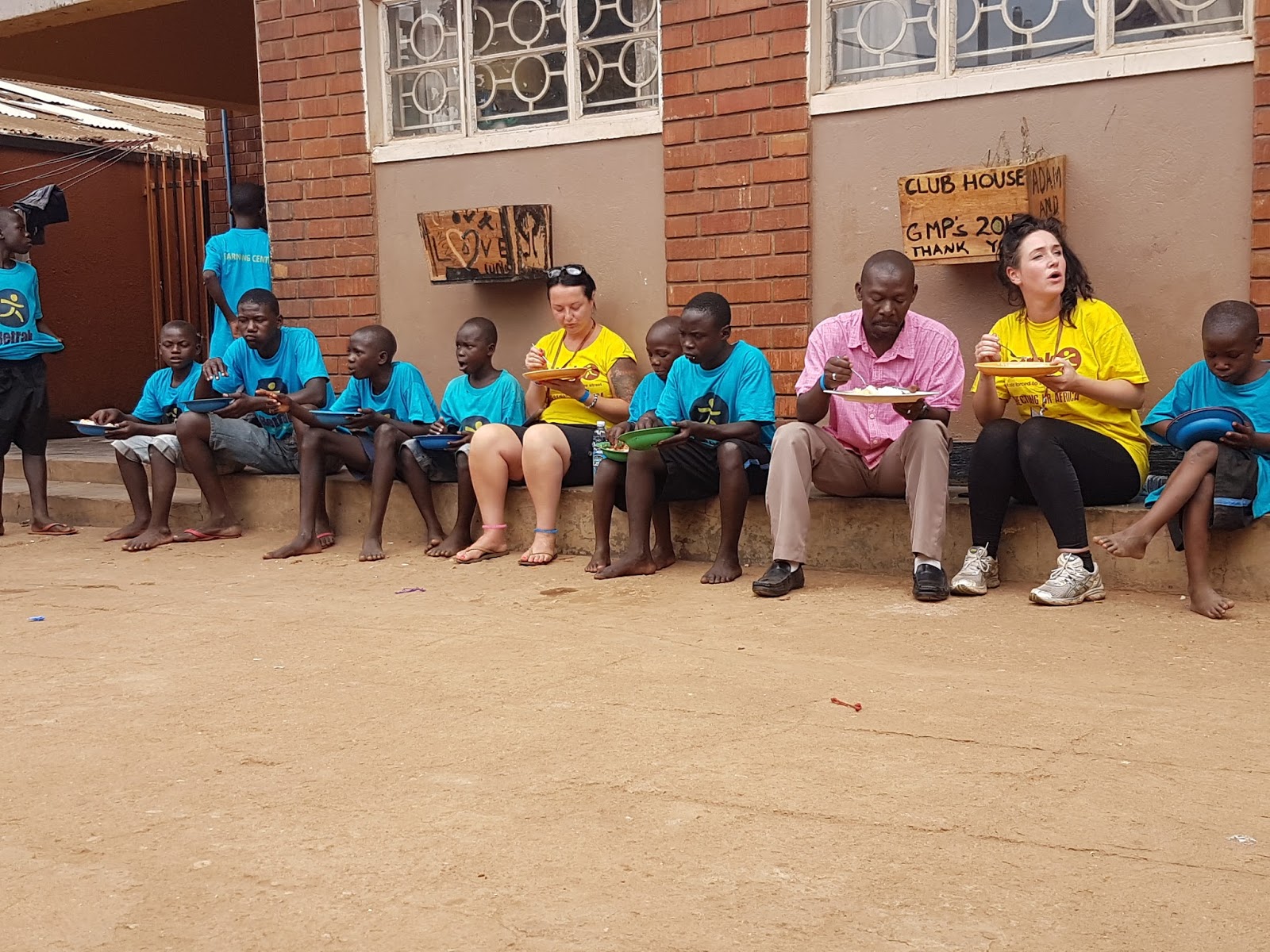
  • Helped with the cooking and serving of lunch


  • Participated in a big outreach to street kids living around the slums; this involved social workers, outreach workers and us pairing up to approach the street children, interact with them, listen to their stories and understand how we could help them.

We heard their reasons for running away:
  • Physical and emotional abuse. Being beaten by their mother or step-mother. Community Chiefs actively encourage beating children to instil discipline.
  • Family breakdown. Father had two wives. Father had died and both wives were ran out from the village. There was no-one to look after this young boy. 12 years old, he was.
  • Wanting an education. One boy wanted to go to school, learn enough, graduate and be a lawyer. A rich one. He wasn’t able to receive this education in his village and has run away to the city in the hope to get on a programme.
  • Sexual abuse. Gang leader’s initiations involve the requirement to perform sex acts or have sex with the gang leader. If you do not conform, you are beaten incredibly badly. Sometimes the punishment is worse than a beating.


With the staff, we used our skills to deliver personal effectiveness sessions to all of Retrak’s centre teams. This was followed by leadership development and coaching for the senior team:
  • Ian led on Resilience

  • Amy & Lisa shared approaches for giving Feedback (a role play with Sophie and myself included)

Teamwork and Values-Based Leadership was delivered by Alice

  • GROW Model facilitated by Kate
  • I wrapped up the session demonstrating the impact of appreciation


We held
  • 121’s
  • coaching sessions


We are providing
  • On-going commitment to support

We made a sustainable difference to so many people during our week together and we formed bonds and friendships that will last forever.

I realised what was missing for me all these years. It wasn't enough to prove to others that I could achieve my dreams from a bit of a false start. It wasn't enough to fill my life with things. What I needed to do was help affect the quality of life for other people, to be there, listen, understand and guide, where I could, to assist in positive life choices. 


Donna had this tattoo done to commemorate her time in Uganda
each star represents a member of the team who were with her

Returning from Uganda, I continued volunteering and became the Ambassador for 3 more charities.
For the first time in my life, I have a full heart. I am complete.

Tuesday, 13 September 2016

Touched

Living in the West, it is perhaps a little too easy for people to sniff in disgust at the poor in other countries and comment that: "Charity begins at home". However, I’d like to encourage you to reconsider. Yesterday I, along with the other people participating in Connecting HR Africa, went with some of the staff from Retrak to visit the street children who spend their days in the slums of Kampala, with the intention of offering them a better life off the streets and away from the slums and open sewers. The children are never forced - the choice is theirs and I am impressed at the respect that is consistently given to them.

Children jumping an open sewer in the Kampala slums
We had both the local area bosses’ permission and an agreement from the police, but even with their support we were instructed to remove all jewellery and watches (even wrist bands and anti-mosquito bangles) prior to setting off, and not to take cameras or phones. Anything of value is temptation to a child who has nothing and, just as the Jack Dawkins (perhaps known better to you as the Artful Dodger) and Fagin (the adult who exploits the children and encourages them into stealing for him) in the musical Oliver!, when young Oliver Twist joins Fagin’s group of street thieves – “you’ve got to pick a pocket or two”.


https://www.youtube.com/watch?v=VogHwP0C5VY

The children in Kampala have no other option than to steal or to allow people to take advantage of them in exchange for food or money in order to survive, and the situation in Uganda’s capital is little different from the horrors that Charles Dickens campaigned against in his books over a century ago. Dickens' serialised novels held up to scrutiny the underbelly of Victorian society. Here in Kampala it is like stepping back in time – there is child labour, children as young as five are in servitude (often as a result of child trafficking); street gangs are run by unscrupulous adults;
 "...the wily old Jew had the boy in his toils. Having prepared his mind, by solitude and gloom, to prefer any society to the companionship of his own sad thoughts in such a dreary place, he was now slowly instilling into his soul the poison which he hoped would blacken it, and change its hue for ever." – Oliver Twist, Charles Dickens
and child prostitution is rife (we saw a girl of about 12, who was clearly seeking customers, dressed provocatively, and a man whom we suspect was a pimp). In 2016 we should have progressed beyond such things, no matter the country. What really struck me when spending time with the street children in the slum was the hardness and suspicion etched on their faces, despite their cheeky grins, hugs, fist bumps and high fives. On the streets nobody is your friend – if you are starving you will steal from anyone, and nobody will help - not even the young person the same age as you with whom you laughed and got high earlier in the day (Maslow got it right, as far as needs are concerned).

55% of children under 5 in Uganda live in poverty. 58% of the Ugandan population is aged under 18 and hence there are few adults to cope with a rising problem – existing social services have been overwhelmed, there is very poor communication between different public bodies – for example although the police are responsible for rounding up homeless children, they do not run the hostels where children should be kept and as a consequence vulnerable children frequently find themselves incarcerated in prison cells with dangerous adults despite having not done anything wrong – in these situations there are often disastrous consequences. HIV is rife and there is a superstitious belief in large parts of the community that if you sleep with a virgin you will be cured of AIDS. Rape is common – and sex is demanded as payment for food or things to make life feel less painful.
 The girl's life had been squandered in the streets, and among the most noisome of the stews and dens of London, but there was something of the woman's original nature left in her still – Oliver Twist, Charles Dickens
Life expectancy for men and women is one of the lowest in the world, and this is unlikely to improve in the near future. AIDS has emerged as a significant cause of death and illness among young children; thus, the already high infant and child mortality rates can be expected to rise. Among children under five, who account for over half of hospital deaths, the main killers are malaria, pneumonia, diarrhoea, and malnutrition. Malaria has been found to be the principal killer among adults admitted to hospitals, while diarrhoea, pneumonia, and anaemia are almost as common as AIDS as reported primary causes of death.

Many of the children we saw in the slums were clearly ill, their noses were running and they suffered from sores and injuries, they were also on drugs – I was offered a couple of small packages of grubby greyish yellow crystals and a sniff of a bottle with a rag at the bottom (many of the children were clutching them). Most of the children in the slums sniff aviation fuel – they don’t do it simply for the gratification of getting high (although the respite from the grind of their daily existence must be welcome);


… one of the side effects of the sniffing aviation fuel is that it prevents the inhaler from noticing the cold when sleeping rough - although it is hot during the day, it can be chilly at night. In addition, sniffing helps suppress the appetite, which is an advantage when food is hard to come by or over expensive (whatever the manner if payment).  Despite providing short-term relief, the long-term harm of sniffing is dire.

This blog is reading like a catalogue of issues but I do want you to understand what it is like, what the donations you have provided will be spent on and the hope for the future. If you haven't given anything, it's not too late and everyone here would be thrilled were you to make a donation to my Just Giving page – every penny contributes directly to the charity and the people it helps. 

I have to confess that, after coming to Uganda and seeing things myself, I am genuinely stunned and impressed by the work that Retrak do. They enable children to come off the streets and start having a childhood. They cope with the drug dependency and mental and physical health issues that the street children suffer from and then help re-establish a sense of self-worth and an appreciation of others and opportunities for the future. It must be so hard trying to reintegrate a child with a family when there were valid reasons as to why he or she ran away in the first place.. I am in awe of the skills and patience of the staff – it takes time and effort to establish trust and make a difference to a maltreated and badly damaged child.

In addition to a shortage of space, Retrak suffers from not being able to respond to the enormity of the problem in Kampala – there are 10,000 children on the streets, but the Retrak establishment that supports children fresh out of the slums/streets only has 25 beds available, so they have to turn children away. 


It was depressing driving through the streets around the bus station last night and seeing how many children there were sleeping in shop doorways.


They believe that they are safer there than in many other locations.

“There were some ragged children in another corner; and in a small recess, opposite the door, there lay upon the ground, something covered with an old blanket.” - Oliver Twist, Charles Dickens
Street children asleep in a doorway, UK 1890
Many Ugandan street children club together and pay one of the guards in residence in the shop doorways to watch over them while they sleep. They lie in front of him on sheets of cardboard, with a rough sack or blanket pulled around them. Other children who cannot afford to pay for the service try to lie close to their more affluent peers and hence the area becomes packed every night with traumatised children trying to secure some rest. The boys and girls who end up with Retrak have some terrible stories - not just as to why they ran away or had to leave home but also the experiences they have had to endure while on the road or once in Uganda's capital.

"I have sat by myself and cried to think of his wandering about in the dark nights with nobody to help him." – Oliver Twist, Charles Dickens

It is interesting how much you can tell about a person from their eyes and expression. Look at the below photograph of Victorian street urchins in the UK. I saw similar faces on boys and girls in the slums.


The children in the slums only smiled with their mouths – their eyes and facial expressions were hard and wary. 


When we headed back from the slums, Pied Piper-like, nearly 100 boys followed us and 80 of these made it to inside the site. After a sleep under the veranda porch, and a medical inspection including a test for AIDS (as a result of which 2 children were taken to hospital that afternoon), they had lunch (which we dished up)


and then went out onto the fields with Alice and some of the other Connecting HR sportsmen to play football. Gradually, as the afternoon progressed, these boys started behaving more like children, as opposed to suspicious and manipulative mini adults with light fingers. They noticeably began to relax and enjoy themselves. Not all of the boys we had fed decided to stay - for some, the freedom outside the compound and the lure of drugs was too strong - they were allowed to leave whenever they wished. The Retrak sites are not gaols and their aim is not to ensnare children into long-term residential care with the charity.


Retrak’s raison d'être is to help get street children off the streets and, ideally, for them to settle back with their families. Individual support and counselling is provided to each and every child, as well as legal liaison with both the police and the courts and facilitation with parents (if they can be traced) and/or foster parents or relatives. On average the process from a child leaving the streets to their being comfortable with returning home to their parents takes 4 months. In addition, there is an embryonic outreach programme being launched, to help families and communities who need it - with the aim of prevention by addressing root causes for why children flee. - such as parental anger inspired by poverty and desperation. 


You could say that, because Retrak’s goal is to help a child become successfully reunited with its family, its journey ends at home. So,  returning to where this post began, but using a different lens, it is true that: “Charity begins at home’ - where the dismissive Western scoffers have said it should be. And my final observation has to be - What the Dickens are we doing allowing street children to be so prevalent, alone and abused? It is impossible not to be moved when here with them. Clearly Charles Dickens himself understood and felt the same.

We should strive to ensure that Dickensian conditions are wiped out across the globe. Together we can make a difference.