Showing posts with label bullying. Show all posts

Friday, 1 January 2016

Comet's tail

Day 32 (New Year's Day - Friday 1st January 2016)

32 muscles can be found in each of a cat's ears (compared to just 6 in a human's).
A cat can turn its ears 180 degrees.
Welcome to 2016 - a whole new year for us to play with. I hope it is a wonderful one for you and all those you care about.

David D'Souza is the contributor of today's New Year's Day post and, no matter how hard you partied last night, I am sure that you will find it an excellent read. You can always rely on David to raise a smile whilst simultaneously making a thought-provoking point - you should try his regular blog for HRD (HR Director magazine) or his own blog, 101 Half Connected Things, as well as his regular posts on LinkedIn. Since April 2015 David has worked as Head of London for the CIPD, the UK-based professional body for HR and People Development, championing better work and working lives. I view myself as extremely fortunate in having David as a friend and former colleague: he is one of the brightest, most innovative, commercially-minded, values-centred and inspirational people I know who is involved in transforming HR and the workplace for the benefit of all. He is a devoted father and genuine partner and pal to his wife, as well as a wonderful friend; being selfish, my only regret since he joined the CIPD is that he works so hard, and attends many evening events, so that I am unable to see him as often as I would like. David - I wish you and your lovely D'Souza ladies (and all of you reading this) an awesome 2016.

------------------------------------------------------------------


So, this year’s topic is Comet’s tail. I looked quite hurriedly at the topic, but it seemed to make sense given the festive timing and the fact that most of you will have picked up your presents from Santa without giving any thought to supply chain conditions.


Retail Week Christmas Index for 2015
An overview of the working conditions at the North Pole:
If you are the reindeer following Comet - or any of the other reindeer at the front - I imagine the view is a little bit unpleasant. Seeing Comet’s tail will be the least offensive part of the role. 


Shackled to a sleigh with an unreasonable expectation as to how much work you can do, you stare ahead and all you can see is another reindeer’s posterior. A black hole of hopelessness. You only get to follow the path already taken by someone else and I imagine that, at times, the whiff of carrots is overwhelming. It must be hard to keep track of progress when your field of vision mainly consists of the (slightly too close for comfort) bottoms of colleagues. I know I wouldn’t fancy that role.
If you are Rudolf you have been part of one of the most celebrated cases of workplace bullying that I’m aware of. Singled out for your nose being bright (last time I checked this isn’t explicitly covered under the Equality Act, surely a shortsighted piece of legislation) it appears that Santa doesn’t really need you unless the weather is even more unpleasant than usual - at which point suddenly you are promoted without any paperwork or mention of an adjustment in salary. And you are supposed to be thankful that, at last, you will stop being teased by colleagues, not because they realise their previous behaviour was wrong but simply because you are slightly more useful to them now.


For the reindeer at the front the experience is entirely different. The crisp night air must be exhilarating as they fly through the air on that most special of nights, delighting in the sense of teamwork that ensures that others follow their direction and multiply their effort. The destination for them must be clear and, even when they are tired, they will be the first ones to realise that a break or the end of the night is coming soon. And their face will be easiest to make out in any team photos.


For the elves apparently you only get one day off a year – at Christmas – and you never get to see the end consumer of your product. They’ve just had their annual break.


For Santa the job is even easier. You take all the plaudits, call out directions and occasionally make motivational noises. All of the thanks come your way – you get pies and alcohol, your team get leftover veg. 


It’s a great job. It’s also apparently possible to outsource public appearances to other people without any hint of criticism.


Each day I work for the CIPD, championing better work and working lives for people.
In the evenings I mainly concern myself with the organisational dynamics of Santa’s operations and what that means for reindeer – the forgotten workers.
So next Christmas, as Santa’s sleigh draws near, spare some time to think about whoever has to look right up Comet’s tail. It’s dark up there.
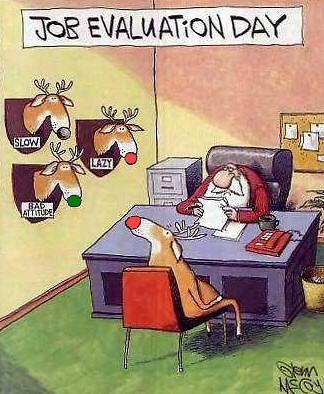

http://www.guy-sports.com/fun_pictures/rudolph_eval.jpg


Saturday, 26 December 2015

A Challenging Year

Day 27 (Sunday 27th December 2015)
27 lunar mansions or nakshatras in the Hindu, Vedic and ancient Indian astrology.
In the West people follow their solar horoscopes, in India the Moon is of greater importance
each mansion is based on the 27.3 day period it takes the Moon to traverse all 12 signs of the zodiac.
Each nakshatra is 13°20’ wide. The series begins at 0 with Aries and runs counterclockwise as above.
The nakshatras are each sub-divided into 4, making 108 sections that are used for divination
(e.g.if your Moon is at 6°. your influence is Saturn). The mansion containing your Moon and its
planet are believed to influence your future, combined with the stars for that period.

Today I am delighted to introduce Helen Green, a talented blogger who is making her first appearance in the Advent Blog series this year. Helen has a powerful background in sales and marketing, working with some of the world's leading brands, where she showed a flair for insight. She has a degree in psychology, a masters in organisational change and is an accredited executive and business coach. She is based in London and runs her own company, Orient8, which she founded in 2011. She is active on social media (you can follow her on Twitter, her handle is @orient8you). As you can guess from the title, Helen's year could be described as "coal dust" - hard found, dirty and difficult, but there is a twist. She has been brave enough to share with us some very personal moments and I am sure we can all learn from her words.


-----------------------------------------------------


It’s been a challenging year.


As I look back on 2015, the standout features are all bad ones.


I was out for dinner recently with good friends and recounted the story of my year to them. One of my friends seemed a bit exasperated with me. She reminded me that I have so much that is good in my life and to be thankful for, despite the challenges.


Of course she was absolutely right.


My brain is Velcro for the bad stuff and Teflon for the good.


Dr Rick Hanson, neuropsychologist and meditation teacher says in his book “Buddha’s Brain - The practical neuroscience of happiness, wisdom and love” –


“we evolved to pay great attention to unpleasant experiences. This negativity bias overlooks good news, highlights bad news, and creates anxiety and pessimism.”


Mmmmm – sounds familiar!


So the chances are your brain is just like mine and you’ve had a challenging year too.


Or have you?


Just in case, I have an insight I would like to share with you.


In July this year, as I said goodbye to my Mum just before she went into surgery, not knowing if it was for the last time, I kissed her forehead, stroked her hair and wondered what on earth I might say. Although my body was screaming at me with pain and fear, stroking her hair had a calming effect and the words started to flow.


“In the end Mum, all there is, is love. I love you.”


Twice recently I have shared this story.


The first time was with a young woman who was really struggling. She has moved half way round the world to be with her love and was trying to work out how she could pursue both of her passions – her relationship with him and the beautiful work which she feels called to do.


We were on a workshop together and I recounted my story as she listened. Tears filled my eyes as I spoke – it is still so raw and powerful - and when I took a little pause I looked at her to discover tears in her eyes too. We let the moment just be, words not necessary as we connected at some deeper level.


Soon it was time for her to tell her story whilst I listened. She told me she had been moved by my story and was starting to notice that what had felt like a tortuous either/or situation, was no longer that way. Love is everything and her love for her boyfriend and for her work mean that however hard it may be to reconcile the two, she knows she can and will do it.


The second time I recounted my story was with a friend who is going through a tricky time in his relationship. After listening to him talk for some time, I told him of my experience.

I said “in the end all there is, is love. Everything else is just stuff. You love each other - don’t let the love go.” 


I was crying again though more softly and in less pain than at my Mum’s bedside.


His response? A silence, followed by a rather breathless “wow, that’s a powerful insight. I just want to hug you.” This was not possible as we were talking on the phone at that moment, but I felt his love - that of a true friend - for me. I know too that he is in some small way changed by that conversation, that connection.


Mother Theresa said;


“I have found the paradox, that if you love until it hurts, there can be no more hurt, only more love.”


And as my favourite philosopher (!) Audrey Hepburn once said;


“The best thing to hold onto in life is each other.”


At this holiday time of year when we get to spend more time with our loved ones, let’s hold onto each other, love (and be loved) until it hurts.


After all, in the end, all there is, is LOVE.


I was mistaken – it’s been a wonderful year.


"All You Need is Love"played live at Buckingham Palace 
by Paul McCartney, Joe Cocker, Eric Clapton and Rod Stewart, 2002


Sunday, 29 September 2013

Intimidation

I was ten, when in September 1973 two stations in central London were targeted by terrorist bombers, injuring 13 people and bringing chaos and fear to the capital.  http://news.bbc.co.uk/onthisday/hi/dates/stories/september/10/newsid_2504000/2504619.stm I lived with my parents and two small sisters in a leafy South West London suburb  - an idyllic and privileged location and upbringing.  My father was a talented lawyer and recently appointed Recorder (meaning that he was expected to sit as a judge for 3-6 weeks of the year).  It was in his legal capacity that he found himself overseeing trials of terrorist suspects and as a consequence his name was placed on that of potential targets.


On a balmy autumn evening in September ’73 my parents and I were sitting having supper with our recently arrived au pair.  My mother had suffered a very difficult birth (requiring significant surgery) for the arrival of my youngest sister, born in March, and hence an extra pair of hands were useful in looking after the family and home.  We talked about the horrors that were besetting London and other parts of the UK and Ireland and, almost as an aside, my father told us to be careful.  Little did we know how prophetic his words would be...


The following day, when he had gone to work and my mother was out shopping the telephone rang.  As the au pair’s English was still embryonic, I answered it.

“There’s a bomb in your house, you’ve five minutes to get out.”

The words chilled me and I tried to get the caller to explain, but they simply repeated the statement and then hung up.  I ran up the stairs shouting a warning and lifted my 6 month old sister from her cot.  With her in my arms and tears streaming down my cheeks I ran to the sitting room, where my three your old sister and the au pair were watching Play School on TV.

BBC's Play School
My middle sister's favourite
“Get out of the house, get out of the house, there’s a bomb.” I kept crying.

The au pair thought I was joking - a game prompted by the supper-time discussion with my parents the previous evening. It was only when I stood screaming at her to leave the house, while I cried uncontrollably, the baby in my arms, outside on the lawn, that she realised I was serious.  I lead her and my sister to my aunt’s house and it was from there that the police were called.  My mother returned to find the abandoned house being examined by bomb disposal experts.  I was never informed as to what happened thereafter.  I can only presume that the call was a hoax.  How cruel to terrorise a ten year old with such a horrific statement - my voice was clearly that of a child.


The experience had a fundamental impact on me.  I learned from that day that people are not always precious nor respected by others and that age is not a factor in how others will behave.  An adult can be less responsible than a ten year old and certainly more unkind.


I mentor a wonderful schoolgirl in Kenya called Catherine.  She goes to school in Nairobi and, since the storming of the Westgate shopping centre a week ago, with the resultant devastating deaths and destruction, my heart has gone out to her and the people of Kenya.  I do not claim to be a theologist, but I have read the Quran and I cannot find passages within it that condone indiscriminate slaughter, especially the killing of children.  It was an undeniable fact that the shopping mall on a Saturday would be full of children out with their parents and friends - there aren’t many other family-friendly and universally enticing places to go.  Over the past twenty years Kenya has progressed from a place where only basic goods were available to a consumer’s delight, but this development is limited and so people tend to congregate in certain locations at the weekends.  In the malls it is possible to buy the latest products that you would expect to find in America, Europe or affluent Asia and therein lies part of the problem.  I suspect the real issue is a clash of cultures and a reaction against rapid change and the imbalances between communities across the continent.  Kenya is one of Africa’s fastest developing economies with a burgeoning middle class.  Much of Sub-Saharan Africa is still almost medieval in the way its societies are structured and people behave - feudal tribes and groups compete for power and territory, with local rather than central control.  Countries such as the Congo, Somalia and South Sudan are dominated by men with guns who extort, rape and terrorise with little to stop them.   I have been told that after nearly 20 years of fighting to run Somalia, the Shabab had finally decided that their dream was impossible and hence were turning to more extremist measures.   What is perhaps most alarming is the manner in which the attack was carried out - not a simple, single bomb but a ruthless group of individuals determined to kill, who actually seemed to target the young and most defenceless. 


Parallels can be drawn to bullying within workplaces and organisations.  Once co-ordinated groups start operating together, to hurt and marginalise a particular individual or set of people, the impact can be devastating.  Cyber bullying has been in the headlines for much of the past few months - the focused, ruthless action of a few destroying the lives of their victims, but similar behaviour can also occur in the physical environment at work.  I have in the past joined organisations where a long-standing group of employees, who were close friends and who had been in their roles for many years, turned on the new hires who were bringing fresh ideas and enhanced approaches - partially because they were afraid of change and a destruction of the status quo.  Often there is a ring-leader who is able to encourage others into behaving in an unsuitable manner.  They know where their victims are to be found and will usually try to hurt and deter them without drawing attention to themselves.  Clearly, these people are not armed with guns and resorting to indiscriminate killing, but even so their behaviour can destroy others’ lives. It is up to all of us to remain watchful and to react when something does not look or feel quite right.  Much better to raise the alarm, even if later to discover that it is a false concern, than not to react at all and for something awful to occur.


Walking out of my house, forty years ago, with my infant sister in my arms and tears running down my face, helped to set my moral compass.  I will always stand against terror in its many forms - life’s too precious not to.  Please join me. 


Friday, 11 January 2013

Speak Up


Just before leaving the office last Friday evening I was invited to participate in a survey by one of the world’s leading specialists in recruitment solutions and consulting, they were seeking my opinions on the employment of individuals with criminal records.  I was interested to see the manner in which they classified criminals, the range stretched from murderers through alcohol or substance abuse addicts to individuals with driving offences.  By coincidence, I have also recently been interviewed by an individual undertaking academic research into the provision of counselling support within the work environment.  There’s a fine line between criminality, addiction and illness.  Illness, if not treated appropriately, can make people behave in antisocial and potentially even criminal ways.


A few years ago, my other half and I went on what should have been a dream trip to India.  Don’t get me wrong, much of it was amazing – and I intend to return.  I often think of Shimla – a hill station retreat, with magical views of the Himalayas, providing a welcome escape from the searing heat in the plains during the summer – in parts the town is very English, with Tunbridge Wells style mock tudor houses, a typical stone church, local theatre and Edwardian era hotels (with hard mahogany beds, beaded lampshades, billiard rooms, stone hot water bottles and names such as Savoy and Cecil), perched on the vertiginous hillside; monkeys regularly disrupted the electricity by severing the cables strung between the roofs.

Shimla

Shimla monkey and Himalayas
I too was disrupted – I was suffering from an adverse reaction to the Malaria tablets prescribed by my UK doctor and swooping depression gripped me in its darkness for much of the time, making life seem futile and myself loathsome.  It was with difficulty that my companion persuaded me to come out of our room and I found the precipitous fall into the valley below dangerously alluring.  It was not until I had this experience that I fully appreciated how debilitating mental illness can be and how little control an individual has over it – you cannot “just snap out of it” and often, while suffering, your thoughts and reactions are not rational.  I am ashamed to admit that, although I thought I comprehended mental illness and the impact that it can have on an employee and their work, my understanding was purely on an intellectual basis and I needed the actual experience of being trapped inside a deep well of despair to make me feel differently about the issues and how I approach mental health in the workplace.


It is extraordinary what an impact emotions and mental well-being have on us physically - I am sure you are familiar with the wobble that affects your voice when you are distressed.  I currently have a paralysed right vocal chord and hence I am dependant on my left in order to speak.  It is noticeable that if I am stressed (for example when I have to present at a demanding meeting or hold a difficult conversation with an employee) there is an audible effect on my voice (it loses tone, rises in pitch and becomes "breathy").   I was in a video conference early yesterday and had some challenging facts to communicate, a colleague in Switzerland noticed the change in my voice and, unable to hear me easily, asked me to speak up.  He and I were both embarrassed when I explained that I could not.  I would have made things easier for both of us if I had let people be aware of the current challenges that I am trying to overcome.  I’m not quite sure why I haven’t made my predicament common knowledge amongst my colleagues – perhaps I don’t want to be seen as weak, called names (even as a joke) or viewed as incapable...


People often don’t speak out – especially when they view their problem as being embarrassing, emotionally or mentally based or of a personal nature and hence inappropriate to be raised at work.  The big news story in the UK today is the joint report by the Metropolitan Police and NSPCC (National Society for Prevention of Cruelty to Children) into the sexual allegations made against the former UK celebrity Jimmy Savile, "Giving Victims a Voice".  Without wishing to diminish in any way the awfulness of the experiences that the victims had to endure, there are some serious learnings for all of us both in and outside work.  The problem was not unearthed (and hence some incidents prevented) because many of the victims chose to be silent and the few who did speak out were not given credence by people in authority.  It now transpires that there were at least 214 crimes, impacting children from as young as eight.  Savile indulged himself in numerous locations, including care homes, at the BBC, in schools and NHS properties and hospitals.   There is no doubt, from the comments of those who have now spoken about their experiences, that Savile's predatory behaviour has had a permanent impact on their lives. 


I am concerned at what prevents people from raising issues before a trouble escalates.  My reticence about my own health is a small example of an individual not wishing to stand out or to be viewed as problematical or incapable within a particular situation.  We need to be mindful of the fact that times change and so do attitudes.  Perhaps the Savile victims did not speak out because of the environment at the time (witness the descriptions now being provided of the internal culture at the BBC in the 1970s in which women felt it easier to accept sexist behaviour than complain http://www.independent.co.uk/arts- )entertainment/tv/news/bbc-bosses-showed-cavalier-attitude-to-culture-of-harassment-8229941.html ).  Returning briefly to the survey I was asked to complete last Friday – even fifty years ago, by knowingly employing a homosexual in London I would have introduced “a criminal” into the work environment (homosexuality was not decriminalised in England and Wales until 1967).  Mental health is still seen as a taboo subject and seldom raised by employees (unless they plan to take you to tribunal for “work place induced stress”!).  But if people don't speak out things will never change.  


Mental health is explored to a significant degree in Shakespeare’s King Lear.  Lear is driven to madness by the indignity and circumstances he brings upon himself (with friends and family turned against him); his Fool (in effect his court jester) is often the only sensible voice, speaking the truth and saying how things should be in a difficult world; Poor Tom (whose madness is feigned by Edgar as a form of disguise and protection) is deemed by Lear to have become insane due to suffering similar misfortunes to himself.  Poor Tom makes the audience question what madness is (much as the reader does when reading One Flew Over the Cuckoo’s Nest and Catch 22).   We live in challenging times.  Increasingly organisations need to employ a diverse workforce who can help them navigate a successful path through the rapidly changing business environment.  We must create a workplace where people are not scared and where they feel safe speaking out for the benefit of themselves, others and the business. 

King Lear, Act III, Scene IV engraving by John Boydell c1792

Given the at times disturbing subjects covered in this blog, I think you deserve a smile for making it this far.  The below video shows what can be achieved if you are prepared to utilise your knowledge and skills but operate in a different way from the norm, especially if you are a little baaarmy (excuse the poor pun): 

Many of the world’s most notable people are those who have been/are prepared to stand out from the crowd, say what they think and achieve unusual things.  It is up to us as employers to create a workplace where a diverse range of individuals are able to thrive and contribute and where their differences are embraced and seen as adding value.