Saturday, 30 April 2016

Time to Plant Trees

“Old men sit in the shade because they planted a tree many years before.” – a traditional Ugandan proverb

In every family there are people who stand out from the crowd – they are the ones to whom the others turn in times of trouble or when needing sage advice. My Uncle Andrew was the pillar and inspiration of his generation. He was an exceptional doctor, with specialist knowledge of tropical diseases, and his working life was devoted to helping the poor of Africa. Have you seen the film, “The Last Kind of Scotland”, much of the story applies to Andrew? Andrew was an engaging, UK-qualified Doctor, with Scottish roots, who went to Uganda to establish world-class healthcare for the people who needed it most. He was much loved and respected – his local name, “Pa Crow”, came about because of his caring observant nature. He was adored by all those who knew him, (but he did not have an affair with Idi Amin’s wife - not least because he preferred men – something punishable by life imprisonment under Uganda’s legislation). As was stated in his obituary in the British Medical Journal, he cared profoundly for the poor and “the rich, if he regarded them in any way as responsible for the plight of the poor, usually received short shrift”). As in the film, my uncle was forced to flee Uganda, under imminent threat of death from Idi Amin’s regime. He was cultured and devoted to continuous learning – his last act, prior to departing Uganda, was the burial of his exceptional library, which included first editions by Sir Richard Burton (the extraordinary Victorian explorer, sexologist and spy) and also his rare collection of Makonde sculptures. The Makonde craftsmen are famous for their “tree of life’ carvings - which show intricately whittled, interconnecting human groups representing unity and continuity. Usually they depict villagers, working together with each other and nature, helping one another, to ensure survival across generations.
In some ways this blog has a similar theme…
Last year I was asked to mentor an amazing young man as part of the Queen’s Young Leaders Programme – the Programme was established to celebrate and support exceptional young people aged 18-29 (drawn from across the Commonwealth) – each and every one of them is making the world a better place. I mentored Edmund who had founded a charity to support refugees, initially in Kenya but now expanded into other locations. One of the ways I was able to help was by introducing him to some of the people in my network who are involved with charities and one of them was Ian Pettigrew, a learning and development guru and trustee of the charity Retrak. Ian is one of the nicest men I know – generous of spirit, highly intelligent and consistently considerate and encouraging. I count him as a friend and over the years we have discussed the work he has been involved in with Retrak - helping street children in various locations in Africa and South America. He told me his dream of inspiring a group of HR professionals to travel to Africa and share their skills and learning with the children, staff and others. That dream has become a reality - a small group has been chosen from those who applied and will be travelling to Kampala in September 2016 under the banner of Connecting HR Africa.  I am proud to be one of that team.
This is not “a jolly” it will be hard work and emotionally and physically demanding. I have operated in Africa, admittedly only for short periods and in a very privileged capacity, and for the past twelve years I have supported a bright Kenyan orphan called Catherine, encouraging her through education and the challenges of transitioning from being a child to an independent adult. Although an orphan, in many ways she was fortunate in that she had a place to live, regular meals and access to an education. Retrak helps those who are often less blessed. There are many reasons why children run away from home – abuse, bereavement, trafficking, desperation, etc. I believe children deserve a decent start in life and that those of us who can should help those who are less fortunate. I also know that problems need to be tackled at their root causes and that one of the reasons that there is a flood of migrants trying to escape Africa is because the problems where they come from are not being resolved. Retrak has an excellent track record of achieving lasting results. The last Retrak annual report, ending December 2014, shows that 96 children were rescued from trafficking, 4,265 street and vulnerable children were provided with help in outreach, placement, and follow up, and 605 children were reunited with families. That is an impressive record.
Part of my commitment to Retrak is to raise £2,000 for the charity. If each of my contacts on Social Media donated £1 I would exceed that amount and between us we would make a real difference. I am asking for your help – no matter how small. I promise that while I am in Uganda I will do my utmost to ensure that every penny counts. I am not requesting support for my travel costs or money for me. All sums donated will go to the charity. If you can help please follow this link to make a donation. 
My uncle Andrew didn’t need to go to Africa – he went because he knew he had skills that could make a difference. In a lesser way I wish to follow in his footsteps. I can never match his brilliance - Andrew was an amazing man in so many ways – although not affluent, he was dazzling – both to look at and in discussion. He was a true renaissance man, well read, cultured, artistic and accomplished (he was also a wonderful cook). He grew up on the fringes of the Bloomsbury Group and was close friends with Evelyn Waugh (I often felt he was like a character in Brideshead Revisited); he became a trustee for Lord Berners’ musical legacy; socialised with The Betjemans, HG Wells, Robert (“Mad Boy”) Heber-PercyCoote and the Mitfords. He could have remained in the UK all his life, been a socialite and shone, but he preferred a harder path, to toil where his skills could add value. 
Andrew in Africa
Andrew only returned to the UK when his own health failed him – he contracted TB and was too unwell to work. He was granted an OBE for his services to Africa but had no pension or savings to support him (he had lost his life savings in Uganda), so he lived with his mother and, when she died, he moved to Somerset to be near his sisters (one of whom is my mother). As many of you know, my mother is currently unwell. I suppose part of my wishing to go to Uganda is to complete the circle. Andrew was my godfather as well as my uncle and I would like to do something worthy of his memory. Uncle Andrew died in my mother’s arms whilst she sang to him the lullaby their mother had sung to them as children. 
A picture of Andrew and my mother
He had no offspring of his own, he never married, but he cared. The theme of children and leaving a lasting legacy is strong – like one of his precious Makonde “Tree of Life” carvings, I wish to be part of a community working together to ensure survival and success for the generations to come. 
I would be very grateful for your support.

Sunday, 17 April 2016

The Dance of Life

Please accept my apologies for being silent for over a month. Life has been a little complicated in the past few weeks. I went to the West Country on the 5th of March to do some work with members of our Exeter office, with the intention thereafter of spending Saturday with my mother and sister in Somerset, as an early Mother’s Day celebration.

It turned out not to be the joyous time that we had envisaged, although the Sunday will probably always rank as my most memorable Mother’s Day. On waking on the Saturday, I went to say “Good morning” to my mother, only to find that she was running a high temperature and was clearly very unwell. She had seen her doctor on the Thursday and been put on antibiotics, so my first thought was that she was having an allergic reaction to the tablets. As the local surgery was closed, I dialled 111 (the UK number to ring for urgent healthcare needs) and, after a succession of calls throughout the day, was given an emergency out of hours appointment at Yeovil Hospital in the late afternoon. By this stage my mother was no longer able to talk coherently, her pulse was racing, her extremities had turned a deep lilac in colour, her eyes were tinged yellow and she was breathing in short panting gasps. When we arrived at A&E the hospital was heaving - there were people on trolleys, lying on the floor and using make-shift beds formed out of chairs and tables. Being the main local hospital, with a wide catchment area, Yeovil is constantly in demand. The pressures on the National Health Service were clearly apparent. Because we had an emergency appointment with specialists, we were seen swiftly and I have only praise for the way in which staff treated us and how they coped in such demanding circumstances.

My sister, who lives with my mother, is mildly autistic and, if it had just been the two of them at home that day I suspect the situation would have been very much worse  - my mother was too ill to call for a neighbour and my sister did not appreciate how dire the situation had become. As it was, that first night was grim - my sister and I sat vigil beside our mother, as tubes and wires were placed into her and machines bleeped.

Understandably, this was very distressing. I acted as translator to them both (although neither was able to fully comprehend what was going on) and I also needed to provide necessary information to the medical staff (things like my mum has only one kidney, as certain medicines or approaches needed to be avoided). When it became clear that my mother would be in for a while (she had sepsis and suspected pulmonary embolisms), I had to figure out how best to support my sister - she was distressed by the hospital environment but also by the fact that our mother was so ill. 

Home is a haven and she needed to recharge, but still have regular access to the hospital. I will remain ever thankful to an amazing local taxi driver called Phil who drove my sister to and from the hospital on a regular basis, always calling me to confirm that he had her on board or that she was safely home. I was able to feed her in the hospital, so I knew she wouldn’t starve, and she was given much needed time with our mum without the constant stress of being in the environment. Over the next four days we were moved from ward to ward (Yeovil Hospital was suffering a severe shortage of beds). My mother was semi-delirious and kept clawing cannulas out of her arms. 

One awful night, after listening for hours to the howls and maniacal laughter of a fellow patient, she became convinced that a nurse was trying to kill her and fought fiercely, in what she believed was a struggle for her life; I suppose in a way it was. It was very distressing. Yet I was just an observer - the brave and dedicated medical staff cope with these pressures and complications night after night. I hope having me there made life a little easier for us all. There were times when I could take the strain or be a source of comfort or information. My work colleagues were brilliant and let me contribute remotely - I devised the HR business plan and budget from the hospital floor, during quiet periods while my mother slept.

Although the staff were supportive of enabling me to remain with my mother (in contravention of visiting hours rules), the hospital was noticeably traditional in the way it was structured and run. With the exception of a junior doctor who helped with admission, all the doctors and consultants we met were male; many of the radiographers and ultrasound specialists were female. 

Almost all of the nurses and care assistants were women, although two men stand out, one a Spanish nurse who had come to the UK because employment opportunities were non existent in his home town. He was bright, observant and proactive, and the other was a chap called America, the night-time care assistant in the ward where we finally settled, who had a skill for making people smile. (As a side observation, an anticipated effect of “Brexit” is likely to be the potential return of many European workers who are adding value here, indeed talking to recruiters and Mark Beatson, the CIPD’s Chief Economist, there is already a reduction in applicants from Europe while people wait to see how the UK votes in the referendum.) 


Given the noticeable gender bias within certain roles in the hospital, it was hard not to ponder why people step into stereotypical positions and work. It is true that male nursing numbers are increasing (in the UK 1 in 10 nurses is now male, compared to 1 in 100 just fifty years ago), but in Yeovil there was a very conventional divide. Is it due to societal attitudes and implicit association that individuals feel steered to take particular career paths? If you are interested in this (and discovering your own latent attitudes) I encourage you to take a few of the IAT (implicit association tests) devised by Harvard University as part of the  Project Implicit research and studies - https://implicit.harvard.edu/implicit/takeatest.html. I surprised myself by how much I tend to prefer the young to the old - something I must watch out for.


Whilst in hospital, it was interesting (if slightly depressing) to see that the NHS can be as siloed as any other organisation, but warming to experience the power of collaboration. My mother’s consultant was a cardiologist, because the clots in her lungs were putting pressure on her heart, and he was very focused on clinical treatment within his area of specialisation. It was Tom, the excellent physiotherapist, who raised the issue that the sepsis had clearly impacted my mother’s cognitive functioning as well as mobility. Infected blood often inflames and contaminates parts of the brain as well as organs. He brought together specialists from across a range of disciplines (speech and language, respiratory, memory and mobility) to see what could be done to improve her quality of life going forwards. Tom was a perceptive force of energy, able to connect people within a bigger picture. I will always remain grateful to him.


I am pleased to report that my mother is now back at home. She needs daily care (we have twice daily visits from qualified specialists - mainly women. Richard and Emma stand out for the way they conduct themselves and communicate). I will continue to spend most weekends and some weekdays in Somerset, but the worst has passed. I doubt my mother will ever be the lady she was six weeks ago again (I suspect she will never drive, go shopping or attend regular lectures and concerts), but she is content and not in pain. My sister has been amazing and, as she is excellent at routine, she is the “nurse” responsible for ensuring that daily medication is taken at the correct times. I am trying to figure out a sustainable future for us all. It is good to be reunited with my family in London - this was the first year that I have not seen my own children on Mother’s Day or been with them at Easter. I am resuming more of my old life (including writing again). It’s good to be back.
On Wednesday night I attended three world premieres - a trio of stunning ballets. In most circumstances, a triad of dances wouldn’t form the basis of a business blog, but there was something unusual about these pieces: each was choreographed by a woman (namely Aszure Barton, Yabin Wang and Annabelle Lopez Ochoa). 


The concept was devised (and all the dances commissioned) by Tamara Rojo, the Lead Principal Dancer and Artistic Director of the English National Ballet, the company that performed the pieces as the triple bill at Sadler’s Wells. Rojo realised that during her 20 years as a professional dancer, with a respected international reputation and recognised flair, she had never performed in a ballet made by a woman. Women have shone in choreography in the past - I live round the corner from the former home of Lilian Baylis, who resurrected the decaying Sadler’s Wells in the 1920’s, by engaging the choreographer, dancer and teacher, Ninette de Valois, to found a ballet company. My husband loves the work of the late German choreographer Pina Bausch and I have been astounded by pieces by Crystal Pite. Even now Isadora Duncan, who both shocked and inspired at the turn of the last century and remains as famous for her gruesome death as her revolutionary choreography, is hailed as the Mother of Modern Dance. It would be tempting to pontificate on why there is a sudden dearth, but, to be honest there are enough comments circulating in the dance and theatrical press on that subject. What interested me, having seen the three performances at Sadler’s Wells, was the way in which they seemed different from dances I have seen choreographed by men.


There was an amusing twist to the front cloth, designed by Grayson Perry, which depicted a central female character surrounded by three thoughts (one for each ballet) whilst situated in a landscape made up of phalluses. 

The cloth was a nice touch - a resurrection of a long theatrical tradition (Pablo Picasso designed cloths for Diaghilev) - they help an audience settle, with a teaser image that hints at what’s to come. I suppose I should not have been surprised that two of the three ballets interpreted the stories of famous women: Medea from Greek mythology and the Mexican artist Frida Kahlo (both heroines suffered unfaithful husbands and had to cope with physical and emotional torment). It was not the subject matters that made the dances unusual, it was the impact and manner in which the dances came across, with some moves (such as the depiction of a miscarriage and the unappeasable pain, centred in the stomach, caused by infidelity and the sinuous effort of trying to break into a group) that resonated strongly - is that because I am a woman?


We live in an often male dominated environment - especially at work. The past few weeks have made me think about gender, the attitudes and impact of others in the workplace, in society at large and how good or poor most businesses are at trying to understand and appeal to their employees, contacts and clients. Now that my mother is on the mend, she is beginning to notice such things, she has become modest and uncomfortable at a male carer offering her a strip wash. I am oddly reassured to see her responding in this way, but it makes me think...

Saturday, 13 February 2016

Not to be taken Lying Down

In the middle of January I was invited by my 8-year-old goddaughter to participate in the Flat Stanley Literacy Project


The Project is a wonderful example of the power of making connections and establishing communities to encourage and share learning. For those who don’t know, Flat Stanley is the lead character in the children’s book published in 1964 by Jeff Brown and illustrated by Tomi Ungerer.


A Canadian teacher, Dale Hubert, started the Flat Stanley Project, in 1995, to encourage letter writing, but it also enhances an understanding of geography, and potentially other subjects such as maths and sociology. In essence, each participating child makes a Flat Stanley (a paper cut-out of the character) and sends it in the post to someone else. The recipient does something of interest accompanied by Flat Stanley (it can be as simple as a trip to the shops or a day at work) and then writes a letter about it, which is sent (along with Flat Stanley) back to the child. It has been a privilege being part of it and, in a hope that it might encourage others to become involved, I am going to share with you my letter.

My House 
Stockwell
London
SW9


Friday 29th January 2016

Dear Sophie,

It was a delightful surprise 
to receive your beautifully written letter and to meet Flat Stanley. I know that he is used to travelling inside envelopes when he goes to visit friends, but he did say that it was quite a bumpy journey to Stockwell, perhaps it was being stuck in a post-bag with all those thank you letters that people send after Christmas. (By the way, thank you for mine; I’m glad you liked the secret code stuff and our trip to the ballet was wonderful). Flat Stanley was clearly relieved to get out of the envelope, as you can see in this picture of him and me.

Flat Stanley arrived at my house on the 16th January.  He and I were very excited to be going on an adventure together and we decided that we would like to have a night out, looking at the lights and sights on the last evening of the Lumiere London Festival. 


We travelled into London by Tube; 

Stanley had to buy an Oyster card before he could get through the gate. 

He loved the escalator. 
   
We went on the Victoria Line to Green Park station and then walked down a grand road called Piccadilly that is full of smart shops and hotels. It was dark and there were lots of excited people crowding around us. The Lumiere London festival is the first time that artists who use light in their pictures and sculptures have put on an exhibition in the centre of London. Stanley and I looked up and saw the statue of a man sitting, glowing, at the top of a building. 


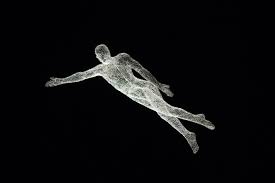
There was another shining man who appeared to be flying in the sky. 


Flat Stanley and I stared up at them and knew that we had an amazing evening ahead of us. 


Further down the road a large crowd of people were staring at a wall that was covered in the colourful, changing faces of film and TV stars. 


They were on the front of the building known as BAFTA, where films and their actors, cameramen and directors are recognised and awarded prizes. 

As we walked along we heard music playing and the crowd around us started moving faster, there was clearly something exciting for us to see.  
Ahead there were lights and strange creatures that looked like huge fish floating in the sky. Flat Stanley and I stood and watched them in awe. 

Then a loud trumpeting sound made us search down a side road and to our amazement we found an elephant’s bottom in the archway above our heads.

No wonder it was trumpeting loudly, it was clearly stuck. We walked to the other side of the arch and there was its head


- Of course it wasn't a real elephant, just a 3d image, but it was cleverly filmed and it made us smile.

We wandered through the streets of central London and saw many amazing sights – there was a walking lady in Carnaby Street 

and little men made of lights, who chased each other and seemed to tumble down the side of a building in Regent's Street.


Flat Stanley liked what looked like a large fishing net, hung over the road at Oxford Circus, which kept changing colour. 


But where were the fish you could catch in that net?

We found them in a telephone box!!!


Being flat himself, Stanley became quite excited when we found a field of flat, friendly faces that were lit up in a park called Grosvenor Square.


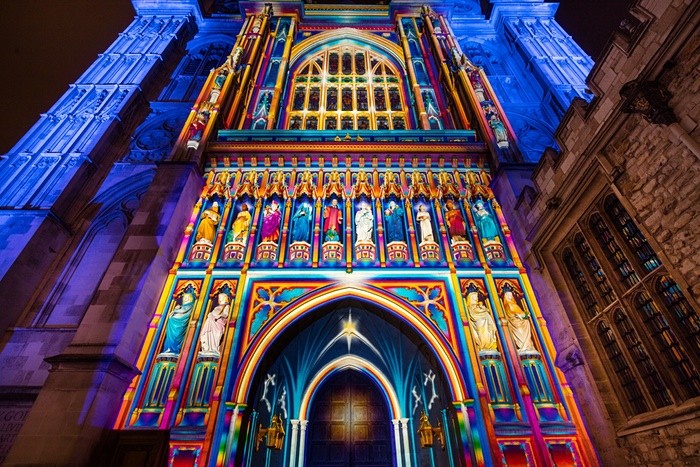
I loved the beautiful lighting used to illuminate the front of Westminster Abbey 

– the saints appeared to glow as if they had been painted by light. It really was wonderful. Such amazing colours and I don’t know how they stopped the lights from smudging into each other.


But it was getting cold and late, so we decided we would head back home.

We walked past the Houses of Parliament (you can tell how late it was by the time on the clock face).


Flat Stanley enjoyed the view from the bridge.


I hailed a taxi.


As a treat, I took us back to my home by cab.

Flat Staley sat exhausted on the back seat, much to the amusement of the taxi driver.


When we got home he fell asleep in a box.


Flat Stanley and I had a wonderful evening - it was exciting walking together in the dark. Thank you so much for sending him to stay with me. I hope your Literacy Project at school is fun – I look forward to hearing all about it.

Lots of love from

Godmother Kate xx


During the course of our adventures I tweeted and shared pictures of Stanley, while we wandered the streets and parks of Mayfair, Picadilly and St James'. My comments were picked up by the Artichoke Trust, the charity responsible for producing the event and encouraging both locals and tourists to see London in a new light. 


Tweet text

It was fun to connect and be able to thank the creative minds who had brought such amazing sights and artists to so many. Flat Stanley and the project is well known around the world and people commented on seeing Stanley on Twitter and encouraged us throughout our walk. You can see some of their comments at the bottom of this post.

It was an odd feeling when the time came to post Flat Stanley and the letter to Sophie - although he had only been with me for a couple of days, I had grown quite fond of the little fellow. Sophie's mother sent me a photo to confirm that he had arrived safely back at Sophie's school and was taking part in the class' wall celebration of all the Flat Stanleys' adventures.


It had been fun. I experienced and gained so much throughout my involvement in the project - none of us is ever too old to learn or to revel in the enjoyment of sharing things with others. Thank you Sophie for inviting me to write to you and for introducing me to Flat Stanley. In a small way all of us involved have helped towards encouraging literacy, enhancing understanding and fostering the benefits of connecting - subjects that should never be taken lying down.

 In reply to 
this has just made me resolve to buy Flat Stanley to read to my girls. Absolute classic.

 In reply to 
Flat Stanley is a great book. It has been a joy to see him again, experiencing