Thursday, 6 August 2015

Shake, Rattle and Roll

After our trouble-laden journey, it was bliss to arrive at the hotel in Antigua (a short drive from Guatemala City), have a shower, grab a bite to eat (our first black beans of the trip) and then exit out into the warm air to explore. 


Picturesque is an understatement for the town, Antigua, is the former capital of Guatemala, with cobbled streets, charming colonial architecture and an easy-going, cosmopolitan ambience. We followed the crowd down the grid of streets towards the main town squares, churches and cathedral.


Antigua is nestled in a broad highland valley with the surrounding slopes covered in pine trees and forest. Its apparent calm belies a turbulent past – both socio-politically and as a result of its location. 
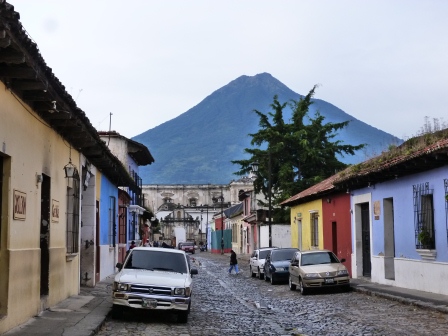


Huge cones of three volcanoes overshadow the town and they have played an active role in its history. Volcán de Agua destroyed the first Guatemalan capital and even now there are shattered remnants of once-stunning edifices destroyed by earthquakes, mud-slides and eruptions. Volcán de Fuego is still active today – snorting small puffs and plumes of gas and smoke into the sky, a constant reminder of the potentially devastating impact of Nature.


People have learned to live with the threat and the architecture reflects this – buildings are surprisingly squat 


with hard cores concealed within pillars to absorb shocks, buttresses and tapered arches to withstand quakes and resist collapse. 


(They remind me slightly of coping strategies used by people under repeated stress – relying on support from friends and becoming entrenched and immovable in the hope of remaining strong and undamaged). 


Our first stop was the church of La Merced – a fantastic example of Antiguan Baroque. Buttermilk yellow - with exquisite, fine white plasterwork decoration like the most elaborate of wedding cakes – some of the ornamentation exemplifying the need of the Spanish invaders to connect with the local community. For example the maize cob and cocoa pod (both sacred to the Maya) are shown under the Virgin Mary, above the doorway, on the glorious façade.


The church was constructed by the Mercedarians (the Order of Mercy was the first religious order to establish a monastery in Guatemala) – they must have been a stoic and determined group of men, as three temples or churches were constructed on the site, and each destroyed by quakes or lahars, before the current building. The first church, completed in 1583 was destroyed in an earthquake in 1749 and La Merced as we know it was completed in 1767. There was a wedding occurring at the time that we visited – with an elaborate banquet and decorations around the famous fountain and under the Mayan-style arches.


We were welcomed inside the church, but tiptoed around and tried not to disturb.


There is a famous figure of Jesus Nazarene, sculpted by Alonso de la Paz in 1650, with noticeably dark skin that appeals to the local community - it is paraded through the streets during Holy Week with thousands paying for the honour of sharing the burden.


I was interested to see the faux mosaic decorations on some of the pillars – these have been created out of small pieces of paper cut from magazines by prisoners.


The church helped sell similar artworks to the public, thereby raising funds to support convicts’ families – the pillar decorations were a gift to the church from the prisoners by way of saying “thank you”.


After La Merced we ambled down Antigua’s equivalent of Fifth Avenue, lined with boutiques selling jade jewellery, art galleries and a surprising number of western-style restaurants and cafes. We passed under the Santa Catalina Arch – inspired by the Corridoio Vasariano above the Ponte Vecchio in Florence, it enabled the nuns to cross from their secluded convent on one side of the street to their buildings on the other without having to come into contact with people.


Just beyond the arch a group of children were re-enacting traditional Mayan dances.


The dance we watched incorporated a Spanish style bull fight – a legacy from the Conquistadors and subsequent colonisation. 


Their costumes and movements reminded me of a combination of Morris Dancers and Pearly Kings and Queens


(a picture of Pearly Kings had bade us farewell as we departed the UK).

British Pearly Kings and Queens
Annual Harvest Festival, Guildhall, London Sept. 2012
We made our way to the main square, the Parque Central. 


This has always been the heart of Antigua – a pleasant place to sit, stroll or observe. It is surrounded on four sides by significant buildings – the Church represented by the Cathedral; 


the State by the Government buildings; 


the Armed Forces by the ancient army barracks and military headquarters (the Palacios de Los Capitanes Generales); and 

Photo by jRo

on the fourth side Commerce, with shops and restaurants hidden under shady arches. 

In the centre of the square is a famous fountain depicting mermaids with water spewing like milk from the breasts – a risky subject matter when it was initially conceived in the 1730s (a time when women were shrouded from head to toe). 


A local story goes that there was a man with four daughters who were very vain. They all decided that they did not wish to marry as pregnancy and childbirth would ruin their good looks (especially their breasts during lactation). Their father berated them for refusing to provide him with grandchildren and told them they had hearts of stone. The following day when he awoke he discovered each of them petrified in their beds and these girls were then placed as the figures on the fountain.


Certainly each girl is slightly different from her peers and the fountain, which is a 1936 replica of the original, is used as an example to the would-be wives and mothers of Antigua.


We explored Saint Joseph’s Cathedral on the edge of the square. Originally the main entrance was up the steps from the square, but most of the building was destroyed in the devastating earthquake of 1773 and what now functions as the cathedral was once one of the side chapels. I have never been into a cathedral in which you have to turn sharply to the right on entering in order to enter the nave. The original aisle and former cathedral has been blocked up and the ruins behind are awe inspiring


It must once have been one of the most impressive cathedrals in all Central America but Nature is supreme. Pillars built to withstand tremors lie shattered on the ground 


and the sky can be seen through the remains of the dome.


Only the crypt, with its two crematoria ovens, remains 


as well as the former underground chapel, where the Spanish nobles worshiped in seclusion. 


This cave-like place of worship has subsequently been retained as a shrine by the locals, with Mayans introducing a carving of the concubine of Pedro de Alvarado (the brutal Spaniard who conquered and ruled Guatemala). Luisa de Tiaxcalaa became in effect the third wife of Alvarado and bore him three children (his other marriages were barren). The complexities of Alvarado’s private life in some ways depicts the complications of Guatemalan history, but more of that to follow…

Don Pedro de Alvarado
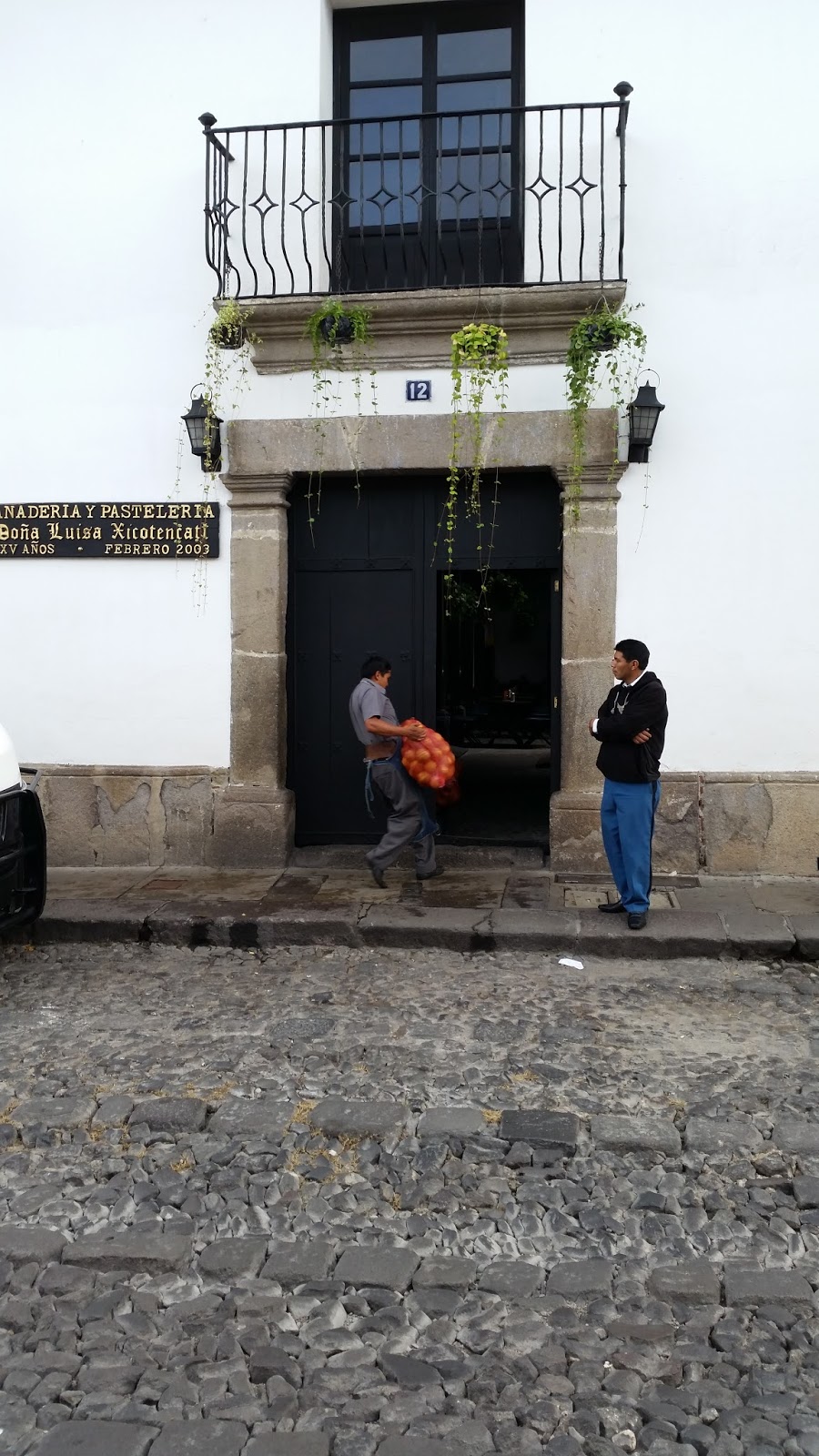
We wandered back to our hotel, past smart bakeries (one housed in the former home of Luisa de Tiaxcalaa) 


and sweet shops.


When we got back to our hotel we discovered that another wedding was being celebrated and we were serenaded by the punctuating sounds of  firecrackers and the marimba, being played on the roof whilst a talented local pianist competed with “Au Clare de la Lune” in the dining room. 


Marimba player

A complex mix from various cultures, at times inspired and often discordant – in many ways a good metaphor for Guatemala.


Views of Antigua

Monday, 3 August 2015

A Port in a Storm

Things don’t always go according to plan and the last 32 hours are, for me, a fine example of the need to be resilient, supportive and flexible in times of change. As is often the case in our household, the whole family was fractious the night before we were due to fly off on holiday – rucksacks, clothing and sunglasses suddenly became elusive (despite earlier assurances that everything was under control) and the pressure of getting ready, within a 13kg baggage allowance, with clothes for mountainous areas, jungle and beach, whilst still desiring a bit of sleep prior to a 5.00am departure, was sufficient to fray most tempers. No matter how much I try to encourage a pre-emptive rather than just-in-time approach to planning and packing, there is an apparently inevitable last minute panic whenever we go away. I am as bad an offender as the others. Friends tell me that this is normal their families, especially those with adolescent sons, but I still find it stressful.


As it was, we and our luggage made it to the flight on time, we even managed an enjoyable family breakfast at Heathrow prior to boarding and American Airways ferried us across the Atlantic with apparent ease. The issues began when we neared America: we were due to land in Miami, to catch a connecting flight to Guatemala (with a two hour gap between arrival and departure) – easy! However, our planning proved inadequate. It is Hurricane season and, just as we neared Florida, a storm was building up. For over 50 minutes the plane circled above the clouds with the intention of landing as soon as the weather cleared, and then, with fuel running low, the pilot decided to head north to West Palm Beach for gas, prior to recommencing the intended descent to Miami. We were one of the first planes forced off-course, but others soon came to join us at this small local airport. It was over an hour before we refuelled. We were not allowed to disembark, so we sat in semi-darkness on the runway and watched the rain pelting onto the tarmac and cement and made racing bets on the rivulets streaming down the window portals.


By the time we finally reached Miami our connecting flight time (scheduled for 16.15) had passed by nearly three hours, but we were delighted when told that, due to the storm, the flight had been rescheduled to 20.20. We sprinted off the plane. However, despite our best attempts, the fearsome queues through passport control, then security (where an officious guard took delight in deliberately splitting our family into two groups, by changing the lane we were queuing in and sending my husband into a different line, despite our requesting her not to do so) and finally baggage claim, where we were told we had to collect and re-check-in our luggage before we could board the connecting flight, delayed us further. Despite our efforts, we were too slow – we, and many others, missed it by minutes (I am unsure why American Airlines could not wait for us, they they knew that we were trying to make the connection after an already difficult journey).  

Miami Airport crowds

It puzzles me that American Airlines provided no obvious assistance at any stage. It was left to passengers to solve their own problems. Having never been to Miami Airport before, it was by chance that we found an area where travellers, like ourselves, were attempting to find seats on planes leaving either later that night or over the weekend. We were one of a great many flights that had been impacted by the weather and the chaos and queues were enormous. The delay was deemed to have been caused by “an act of God”, and hence our difficulties was not covered by American Airways’ insurance, so there was no offer of a room for the night, food or compensation. It was now nearly 9.00pm – we were tired and hungry. We had been travelling all day and were now stranded in Miami, when we should have been in Guatemala where a bed and dinner awaited us. Checking on Trip Advisor it was clear that all the nearby hotels to Miami Airport were already fully booked and we had to stay in line so getting food was not possible.

At last we reached a desk and a wonderful customer service representative at the check-in, her name was TJ, took us under her wing, when she realised that we had been travelling for 21 hours, were now stranded and still had a long way to go. On seeing my crestfallen face, when she told us that the earliest flight she could get us onto from Miami to Guatemala was on Sunday (it was still Friday at this stage), she rose to the challenge of determining whether we could fly to another US airport and then on to Guatemala from there. Watching her struggle with the computerised booking system was like watching a person trying to grasp mercury between their fingers and thumb– every time she thought she’d found seats they vanished before she had time to process them - clearly we were a few amongst many suffering our fate. We knew there were possible flights out of Dallas, the first being 9.00am the following morning, but, due to “a technical issue”, TJ was unable to make any confirmed reservations using the system – she was as frustrated as we were. To make matters worse the last flight to Dallas that night, at 9.20, was already fully booked and the airport was heaving with frustrated would-be-passengers. We agreed to risk stand-by – as provisional bookings were the best we could get. TJ left her desk and escorted us in person to security, explained where the departure gate was and waved goodbye as we ran. She was our port in the storm and I will be writing to American Airways to commend her.


We made it to the departure gate in time, but as it was the plane was delayed - the flight bringing the aeroplane in to Miami had been impacted by the storm. As time ticked problems got worse - new pilots became required (so as not to contravene working shift limitations) and at 11.30pm we were informed that, because the plane had been left with its lights on and with other electrics running,  the batteries were now flat and needed replacing. Then the plane was moved to a different departure gate and all would-be passengers traipsed across the airport and continued to wait. The departure time kept moving, from 11.30pm to 12.15am, then 1.30am, then 1.45am and finally at 2.00am the flight was called.  My husband is a frequent flier and his name was bumped to first place on the stand-by list. I too am a frequent flier but, because this information had not been entered prior to our departure from the UK, I was not allowed to benefit. I explained to the staff on the desk that it was important that my youngest son, being a minor, was not forced to travel alone.  As I was telling the staff this, two American Airline employees arrived wishing to fly to Dallas that night; they were immediately allocated two seats, much to the annoyance of the twenty or so people waiting on the standby lists.  Then my husband’s name was called as the only standby. We decided that getting at least one of us on their way made sense, so he boarded the plane leaving me with the boys.

There must have been nearly thirty of us hoping to catch that flight – most with connections to make or families to return home to. It was nearly two o’clock in the morning and everyone was trying to be supportive and polite. The two ladies manning the desk at the departure gate had been on a shift that was supposed to end at 5.00pm and yet, as the flights were so messed up, they were having to work on through the night, having been messaged that they were on overtime. A delightful Mexican lady told me that she had agreed to look after the passport and ticket for a fellow passenger who had wanted to go to the bathroom, but did not want to lose her place in the queue as she had a flight to Tokyo from Dallas the following day . We moved to the amended departure gate during the time that she was away and for 45 minutes there was no sign of her. In the end we persuaded the lady at the desk to make a call in Spanish over the intercom and then I looked after another lady’s son whilst she checked the restrooms in case the missing woman was unwell.  It was the little gestures that we all made to make things easier for others that helped to make the evening easier. At 2.15am, minutes before the plane was due to depart, three further standby seats were announced and it was agreed to give one to my youngest son, so that he could travel with his dad. I hugged him and waved farewell as he disappeared down the jet bridge.


Once the fight had departed my other son and I, along with all the other disappointed passengers, were left to find a fresh solution to our predicament.  The two of us knew that if we did not get to Dallas for 9.00 am on Saturday there would be a further delays that would impact our trip; we were scheduled to drive to Lake Atitlán in the Guatemalan highlands on Sunday. I found a tired American Airline rep and asked about seats on the 6.00am flight to Dallas – which was now less than four hours away. Again, it was full there was only standby by, no guarantees. I asked that my son and I could be placed on the list. By 5.30am that list was 48 people long, but it was compiled on a first come first served basis and my son was at the top of the list, followed by me.  In case you ever find yourself in our predicament, let me warn you that Miami Airport has uniform seating arranged in rows with sturdy, but sharp, metal armrests that prevent people from lounging, canoodling or using the seats as temporary beds. 

In the two hours available to us, my son and I tried to sleep on the floor near the departure gate for the 6.00 o’clock flight. 


I tenderly placed my pashmina around my boy – I haven’t tucked him in for a few years, but by this stage both he and I needed to feel loved. 


I was woken at 4.37am, by a cleaner removing stains from the carpet, he sprayed me with the stain removal fluid before starting the engine of the carpet cleaner he pushed between the rows of chairs. By the time he had finished the area of floor where I had been lying was drenched. I could not go back to sleep, but I persuaded him not to disturb my son.


At 5.05am I went and found coffee and empanadas for breakfast – for Brits an unusual start to the day – and with these offerings I woke my son. I suspect my eyes looked as red and sore as his and we both needed a wash, but at least we could smile. To cut a long story short, Fortune’s wheel finally seemed to have turned for us. Both of us secured seats on the 6.00am flight and we landed early at Dallas.  Fellow passengers gave us advice on how to navigate the airport – it is quite large. – the 4th busiest in the United States and 8th busiest in the world, with two terminals exclusively for the use of American Airlines. The Sky Train at Dallas/Fort Worth Airport swiftly took us to our desired terminal and we caught up with my husband and youngest son by the departure gate in time for the 9.00am flight to La Aurora, Guatemala’s City’s international airport. We arrived in Guatemala 17 hours later than intended, but we are here and now the holiday can truly begin…