Showing posts with label division. Show all posts

Saturday, 17 December 2016

Hatful of Hollow

Day 18 (Sunday 18th December 2016)


18 UK rejections before his novel was accepted by a publisher, Oneworld,
and now Paul Beatty is the 2016 Man Booker Prize winner for The Sellout
It is a biting satirical novel about a young man's isolated upbringing and his 
attempt to reintroduce segregation and slavery in LA leading to a Supreme Court
case. It is at times a very funny read.

I hope you are enjoying the last weekend before Christmas. Today's blog has been submitted by Peter Cook, whom I first met on Twitter a number of years ago (his handle is @AcademyOfRock) and it has been a pleasure watching his businesses go from strength to strength (albeit with the occasional wobble en route). Peter leads two consultancies: Human Dynamics and The Academy of Rock - a combination of them both enables him to follow his three passions; science, business and music. Peter is creative and enjoys facilitating strategy and enabling change through bespoke consultancy, masterclasses, keynotes, training, coaching, mentoring and music. He has contributed to 11 books and is in the process of writing another, having been commissioned to do one on businesses where ideas, insight and intelligence (both human and AI) can be demonstrated as enabling competitive advantage. He also writes a blog - Human Dynamics. As you can tell from the below blog, Peter says it how he sees it (often with considerable passion). His heart is in the right place...


*******************************

Hatful of Hollow


I’d like to write a seasonal post about my personal triumphs of 2016 and there have been a few, but, for me, world affairs loom larger than personal successes and, ultimately, our personal fortunes are connected to the overall health, wealth and happiness of those we share the planet with. So I’ll begin this review in the “Morrissey style of reflection”.


To Brexit or not to Brexit? That is not the question

I was dismayed at the level of post-truth politics that led to our decision to leave the EU by a slim majority and subsequent confusion about what we actually voted for. Lies abounded on all sides, but none so gross as the adaptation of 1930’s Nazi imagery to install and validate xenophobia into our populace. The other whopper was the suggestion that we’d get £350 million a week back for the NHS, a promise that was denied by Nigel Farage the very same morning that the referendum result was announced.  I set my views out about post-truth politics in “Brexit Means Brexit” and “Should I Stay or Should I Go”, so I need not rehearse them further here. Suffice to say that I remain of the view that democracy based on gross lies is not democracy but part of a general decline into a banana republic, which depresses me and makes me and my family consider our eventual departure from the DisUnited Kingdom.

Most people I meet in Europe believe that Brussels needs some reforms, but the idea that we can leave and then have an à la carte relationship with the EU is the epitome of arrogance and stupidity. It also demonstrates the complete lack of understanding about negotiations by the vast majority of my fellow citizens.  It’s as if I were to decide to stop paying the subscriptions to my local golf club.  So I go to see the golf club boss and say:

“I want to leave the golf club … but I still want to attend all the gala dinners … and I’d like a month’s unlimited use of the club for my Commonwealth guests … and I want a free set of golf clubs every year … is that OK?”

I am then surprised when the golf club boss Mr Junkers advises me that I am not welcome at the golf club and that he is quite annoyed with me, since I have been “encouraging others to leave”. Quite unsurprisingly he tells me that he will not comply with my requests and I must leave promptly and quietly, as he must defend the golf club to prevent contagion from other members …

I have been punished for my views on the EU via social media, having been warned by a senior HR person in a global computing company, who felt that expressing any political views would be bad for my business.  I was physically beaten up in the street by an angry young man. I also had to despatch members of my family from my house after my brother-in-law refused to discuss the fact that he voted leave “to stop two million rapists coming to Britain from Germany”. But some things are too important and I will continue to devote time and energy to stopping our “self-harming Brexit Strategy”.

In case anyone would think my views on Brexit are driven by self interest, my own business has actually profited from Brexit in the short term, having been 20% more attractive as an export business and I have delivered projects in Mauritius, California, Italy, Germany and Scandinavia in recent times. But I do think that 30 pence a day to belong to an institution that has helped preserve peace for more than 70 years is a price worth paying. I’d like my children to be able to enjoy the series of social, economic, employment and environmental benefits that Europe has to offer.  I feel largely the same about the emergence of Donald Trump and the alt-right in the USA, but I doubt you would continue to read this rant if I developed the theme.  If you wish to continue you may find my reflections on the visit to The Bob Dylan Exhibition and my meeting with Bianca Jagger insightful in respect of Mr Trump.

But all adversity is usually matched by opposing forces and I was delighted to see the results of the recent elections in Austria and Richmond, where the main drivers of the vote seem to have been more humanistic and collaborative in nature. Perhaps we’ll reach a tipping point in 2017.

The Queen is Dead … Queen Bitches, Princes and Heroes


2016 was marked by a higher proportion of high profile deaths than any year I can remember, some taken at an early age. In my case the passing of Prince and David Bowie were very important losses, having lived with these people spiritually from an early age and been close to the point of getting to meet Prince in person, having interviewed a number of his “musical family”.  Along with Victoria Wood, Leonard Cohen, Andrew Sachs and too many others, it somehow seems that these people knew what was about to happen in the world and left the stage early.

Ouija board, Ouija board, can you help me?


We live in disruptive times, some simple natural consequences of our biology, others essentially “self-harm” driven by desperation and alienation with those who lead us. In both cases, our responses to such things must look after those we love whilst seeking to leave the planet in better order than when we arrived. In many ways, adversity means we must redouble our efforts to make the world a better place.  I am very lucky really, having worked tirelessly over 23 years to develop a resilient and agile business. This has enabled it to survive two recessions when most have crumbled in the gig economy. Some of the 2016 highlights amidst a “hatful of hollows” have been:

·      The launch of my 7th book for Bloomsbury and the commissioning of the 8th for Routledge. I was delighted and surprised to win the Bloomsbury commission and even more so with the request from Routledge, for which I’m now seeking case studies around the theme of “Brain Based Enterprises”.

·      Consulting assignments across the world: This included acting as the guest of honour at the University awards ceremony in Mauritius and delivering a conference in the famous Grand Hotel in Rimini, staying in the suite chosen by the iconic film director Fellini.

·      A major new global business speaking partnership with David Tait OBE.  David was Sir Richard Branson’s first hire at Virgin Atlantic and was instrumental in the airline’s development.

·      The launch of a major project to help beat world cancer. The project failed in the first instance mainly due to the lack of a sponsor, in-fighting between various cancer charities and the fact that it nearly bankrupted me as I put my own time and money into it. It stands as a monument just awaiting someone with resources to pick up the threads at Beat World Cancer.

·      Interviews with Prince’s bass player Ida Nielsen, his sax player Marcus Anderson in the Royal Box at the London Palladium, the man who engineered Queen’s classic “Bohemian Rhapsody” and the first transgender star from “The Voice” Jordan Gray.

My priorities for the future are to continue to develop my business internationally to be responsive to an uncertain future and to help my children start out in a hostile world of employment where a war for talent is matched by a war for wages in the gig economy. Despite a hatful of hollows in 2016, I believe in a thing called love and I hope we will transcend the current problems that are sweeping the world. I leave you with a song:


Saturday, 3 December 2016

Shock and "Or..."

Day 4 (Sunday 4th December 2016)


4th ever closure of Disney World in its 45 year history
occurred from 5.00pm on Thursday 6th through to the end of Friday 7th October, 
due to the threat posed by Hurricane Matthew. The other 3 closures 
were also due to hurricanes - twice in 1999 and once in 2004.

Today's piece is written by my friend, David Christensen who was a fellow student, in the same college as me, at Cambridge - many people were surprised that we socialised together and enjoyed each other's company - he was (is) seriously clever and does not tolerate fools. David attained a First in Maths and Computer Science and, long before most of us were aware of the power of technology and the use of algorithms to solve complex global and business problems, David was leading the field. He is internationally recognised for the work he has done, over a number of years, to develop stochastic modelling tools that enable effective financial modelling within the insurance industry. David was a driving force in the team that established Igloo as the leading product across the sector - it is used by more than 700 insurance organisations around the world - actuaries are in awe of him. David works for Willis Towers Watson, where he is the Technology Leader, specialising in technical research and development in insurance capital modelling, within the Property & Causality team.


There is much more to David than just being good at maths and coding, he is well-read and well-travelled (even by bike in Cambridgeshire). Possessing an excellent palate, he (and his inspirational wife Sarah) have enjoyed sampling superb wines and fine food in locations across the globe. They stand out (and not just because they are both tall). In addition, they are both crack shots - David has been the County Champion for Clay Pigeon Shooting for Cambridgeshire and is one of the best competitive shooters in the country. I hope his post hits the mark for you.


**************************************

Shock and "Or..."

Thank you to Kate Griffiths-Lambeth for inviting me to contribute an Advent blog under the theme of Heights, Hollows and Hearts. Perhaps unsurprisingly, given the events of the year, I intend to write about opposites (Heights and Hollows) and how emotions and beliefs (Hearts) can form barriers between them. I also hope to suggest some small steps we can all take to attempt to add some level of control to the out-of-control juggernaut that is political and social interaction in 2016.


I don't make any claims to originality in what I say here, although the exact expression and examples are my own. Recent events have caused quite a few people to say similar things. This doesn't make the message any less worth spreading, so I hope my attempt to get people thinking about it via Kate's blog can do some good. While I will be discussing political events, I am trying my hardest to distance this piece from political opinion; it is the preservation and development of social niceties that concerns me more than the political outcomes.


This picture does NOT indicate the writer's attitude
but it makes a point about some people's stance within our society


The Context

2016 has featured two elections (so far!) with important results that many were stunned by. 

In an age of ever-faster communication and increasing coverage by traditional and social media, how can so many people have been so surprised? I'm not talking about the failure of polls (although that is a fascinating subject), but about the shock and disbelief that many (winners and losers) felt after the results. Amongst my friends there was a chorus of "how could it have happened?" and "how on earth could anyone think voting the other way was sensible?" and a saddening quantity of "are they all idiots?".


Filtered Truth

I believe that the increased ease of communication and sheer quantity of information available to everyone via technology has had two interesting effects. Firstly, because information is easier to get hold of, you need to talk to fewer people to get it. For example, it may be easy to discover online that say 73.8% of your near neighbours have opinion X as opposed to Y. If you also hold opinion X, it is easy to stop there, because 73.8% is nearly everyone, right? 


Nothing in this process has done anything other than confirm your belief. If you'd had to go out and ask people, you'd have encountered about a quarter of people disagreeing with you, and some of those would probably have gone beyond a straight X/Y statement, and you would have been exposed to some Y opinions.

Tailored Truth

Furthermore, when you look further afield, you are most likely, these days, to do it via either social or conventional media. Let's start with conventional media: sadly, most newspapers and TV channels these days are highly stuck in their ways. You're not going to confuse a Fox News report with a BBC one very often! Since peoples' views also tend to be static, they will tend to find a channel/paper they agree with, and then stick with it; it's a rare individual who chooses to immerse themselves in things they disagree with - I like to think I have an above average interest in engaging with opposing views (or "argumentative" as some say J) but I still read the same daily newspaper my parents introduced me to in the 1970s.


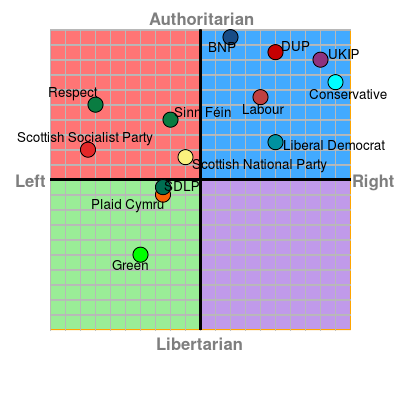
Since you're likely to be stuck with your political leanings, you might want to measure them.

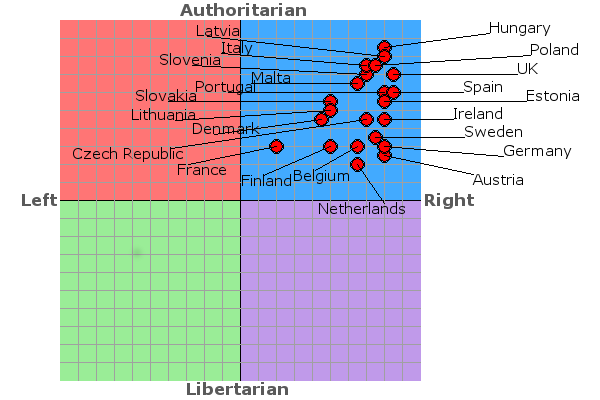
Luckily there is a website, politicalcompass.org, that allows you to answer a few simple questions to place yourself not only on the left/right political scale, but also the libertarian/authoritarian scale. You might be surprised where you end up - I was. For comparison, they will place on you a graph with the main parties or candidates in recent elections. For example, the UK 2015 election on the left, or (perhaps more alarmingly) governments in the EU as of 2012


Social Media

Social media has picked up on this desire to be surrounded by literally agreeable content, and subjects you to two forms of confirmation of your opinions.
  • Apps such as Facebook that allow you to share discussion with "friends" mean that you will mainly see and hear your friends. It's not like overhearing the next table in the pub or someone talking too loudly on the train. If there is someone in your feed saying things you disagree with, you can block them or unfriend them and they effortlessly go away.

  • Like all the worst narcissists, the tendency is to surround yourself with mirrors and yes-(wo)men.
  • Social media is a major news source these days; Pew Research published data in May that 62% of US Adults get news from social media, more than twice as many as read newspapers . And guess what? Social media companies want you to keep coming back to their sites (so you can click on adverts), so they try to make sure that you only see news you like. You effectively have your own confirmatory newspaper - perhaps it should be called the Narcissist News?


The problem with being presented with news you agree with is that it makes you less critical of its contents. Known as "confirmation bias", this is the natural human tendency to believe things which agree with our original thought and disbelieve things which challenge it. We all do it, to a greater or lesser extent (I haven't found any evidence to the contrary).

The Problem

Despite surrounding ourselves with a hall of virtual mirrors, the reality is that things are not homogeneous. In early June, I drove a route which took me through both Cambridgeshire and Lincolnshire/Yorkshire. I doubt that many people in either location were aware of quite how polar opposites they were on the subject of the EU referendum. The scary bit is not the difference of opinion, but the lack of understanding of the existence of dissent (particularly amongst those supported the status quo). The problem that I see is that the vote - even more than the US election - hasn't really changed anything. There are still two camps who don't talk to each other much, and, when they do, I generally see an argument that gets people nowhere.

How not to argue

Typically, post-vote arguments go like this:


Person APerson B
I believe X
You're wrong
No, look, here's a logical argument as to why X is right
I don't care, I believe Y
But here's a logical argument as to why Y is wrong
I still believe Y
I think you're stupid/ignorant
You're just trying to prove you're morally or intellectually superior.


This argument often occurs between (I'm using these terms very loosely) a rationalist (A) and an emotionalist (B), and not always representing the same sides of the argument. I think this is because obvious when two rationalists argue the points around the votes, they realise that the issues are way too complex for a short argument and it fizzles out. Two emotionalists have probably either unfriended each other, got into a fight, or realised there is nothing but pain in continuing. But when you get rationalists and emotionalists arguing the point, it seems to run and run with many variations on the same basic theme. I do wonder whether there is a meta-problem here; arguments about different beliefs are least productive amongst rationalists and emotionalists because they don't even notice that rationalism and emotionalism are themselves different beliefs.


Anyone who does not understand their opponent is condemned to repeat themselves endlessly (or disengage to go and talk to someone they agree with).

Ask a Professor

To quote Randall B Smith, Scanlan Professor of Theology at the University of St Thomas in Houston (full article here), talking about his frustrations with today's students:
The more students dismiss the resources of critical reason, the less faith they have in reasoned judgments. The less faith they have in reasoned judgments, the more likely they are to assume every decision they find offensive is based on ill will or gross stupidity, and the more indignant they are likely to be in their condemnations. The louder and more intractable the disputes between parties, the more those with less stomach for the fight will withdraw into postmodernism's "ironic detachment": the shrug of the shoulders and the ubiquitous "whatever."
However, I think this lack of critical reasoning ability is only part of the problem. Increasingly I think that people under-use "why?" as a question. In the hypothetical exchange, above, what A should be doing is not presenting an argument as to why A thinks Y is wrong; A should be considering why B thinks Y is right. A is not trying to change his own belief system (although I would argue he should always be challenging it), he is trying to change B's. You don't win an argument by establishing an abstract truth (that's science !), you win an argument by changing a belief.


Why did they say that?

What we all need to do is to understand why people think differently from us. It's not that person B was born believing Y. Something made them think that. It may be as simple as their "sources of truth" are different to yours - which may be on any number of levels: the effect of hundreds of smart students from the EU adding to a varied discourse at Cambridge University will present a very different "truth" about immigration to thousands of farm labourers from Eastern Europe disrupting the labour market in Lincolnshire. But neither of these groups is very likely to see the impact on the other, even if they could be persuaded that it is the overall sum that matters rather than the individual impacts. It may be from which newspapers you read; if your paper tells you three things which you know from experience are true, then you are also likely to believe the fourth thing is says that you don't have experience of. It may be as simple as parental influence. These latter two raise the question of why did their news source or parents believe something...


"Yeah, but we won"

The way many of the post-vote arguments end is with "yeah, but we won". Whilst this may be true, it is meaningless on two levels. People decry Twitter for 140 character tweets being too short for real information. But a referendum is 1 bit: yes/no, in/out. It is the minimum amount of information it is possible to convey. Even the question for the EU referendum was less than 2/3rds of a tweet. So whilst one side "won", it will be years before we know what they have "won". 


Secondly, it's not like winning £1M in a lottery, where the winner gets it and the losers don't. We all get the result of the vote. Bar those fleeing the country in horror, we have to stay and live with it. And with each other.


What to do about it

If we are to peacefully coexist in this post-vote world (and I do worry that peace, both domestic and international, might be at risk), then we need to understand each other more. We need to try to de-polarize our belief systems and information sources. We need to welcome a challenge to how we see the world. We need to understand why others think what they do. We need to share understanding rather than trying to destroy conflicting views. We need to win over hearts as well as minds, and concede that we, too, may be swayed, whoever we are. When we encounter a nasty surprise, we need to move on from the shock, and consider the possibilities of "or..."


Since this is an Advent blog, I'll conclude by saying that if we can all make just a little progress in these areas, then we may be on our way to a Happy Christmas!


David Christensen

Links for further reading if you haven't had enough already
A Call for Intellectual Humility
Confirmation Bias
Don't mistake an assumption for a fact and (same site) The genetic fallacy: When is it okay to criticize a source?
British Newspapers - you are what you read (not least for the amusing video links)
Creative Commons Licence
This work is licensed under a Creative Commons Attribution-ShareAlike 4.0 International License.

Late on Friday night David contacted me and suggested I simply scrub his post and put up the words to rock band Rush's "Second Nature" from the album "Hold Your Fire" as, despite being released in 1987, the lyrics seem to encapsulate much of what David has said above.


"Second Nature"
A memo to a higher office
Open letter to the powers that be
To a god, a king, a head of state
A captain of industry
To the movers and the shakers...
Can't everybody see?

It ought to be second nature
I mean, the places where we live
Let's talk about this sensibly
We're not insensitive
I know progress has no patience
But something's got to give

I know you're different
You know I'm the same
We're both too busy
To be taking the blame
I'd like some changes
But you don't have the time
We can't go on thinking
It's a victimless crime
No one is blameless
But we're all without shame
We fight the fire while we're feeding the flames

Folks have got to make choices
And choices got to have voices
Folks are basically decent
Conventional wisdom would say
But we read about the exceptions
In the papers every day

It ought to be second nature
At least, that's what I feel
Now I lay me down in Dreamland
I know perfect's not for real
I thought we might get closer
But I'm ready to make a deal

Today is different, and tomorrow the same
It's hard to take the world the way that it came
Too many rapids keep us sweeping along
Too many captains keep on steering us wrong
It's hard to take the heat
It's hard to lay blame
To fight the fire while we're feeding the flames