Showing posts with label Power. Show all posts

Monday, 17 December 2018

Heartaches, hopes and high fives - Day 18

Tuesday 18th December 2018

18 - the number of chapters into which James Joyce's modernist novel, Ulysses,
is divided. It was initially published in installments in an American journal, but was then
released as a complete work on the author's 40th birthday. 
The novel's stream-of-consciousness
technique, careful structuring, and experimental prose—replete with 
puns, parodies, and
allusions—as well as its rich 
characterisation and broad humour, have led it to be regarded
as one of the greatest literary works in history
The Christmas silly season has arrived - lunch in Cambridge yesterday followed by supper at the RAC. I will need to pace myself. (I say that to myself every year and I seldom manage, but I am exhausted - this year has been more demanding than any I can remember). But enough about me, onto the blog...

In many ways, today's post is a perfect follow-on from Niall's of yesterday and Nick's from the day before - it considers our world, how small we are within it and has hope for our future. It has been written by David Head. David is a highly respected executive coach and mentor; he specialises in supporting people through periods of change and career transition. Just over five years ago David decided to move down a slightly different branch in his own career, away from senior search within the IT sector and qualified as a coach. Since 2013 he has worked for the award winning, London-based business performance and leadership consultancy, Accelerating Experience, as an executive coach and mentor. David for many years has been a keen sportsman (tennis and golf) and is also well read and an erudite writer - you would probably enjoy his articles posted on LinkedIn. You can follow him on Twitter - his handle is @DavidAHead2. It is a pleasure to have him back in the series this year. 

****************


This image of the Northumberland coast (you can just see Bamburgh Castle in the background), recently won an amateur photography award and was taken by a friend, John Chappell.  I chose this image because the sea is significant to most of us on these small damp islands. It is somewhere we go to have fun, reflect and take stock. Significantly, it ‘delivers something the soul loves too’.

I love gazing out to sea, particularly at this most moody, evocative time of year. 

Looking at this image you can sense the eddies, currents and flows going on under the surface, rather like our own thoughts, feelings and emotions. The sunset in the background represents a sense of hope to me, or is it the fading of the light?

It is this sense of ambiguity which draws our wandering minds and souls in, like mariners navigating the unseen flow of our unconscious.

‘We are tied to the ocean..and when we go back to the sea, we are going back to whence we came’John F Kennedy
From dry land the sea becomes restorative and nurturing, soothing our deepest heartaches and fears. Stand silent, gaze out and sense the darker and unknowable, yet instinctively known forces of life, and death.

The sea is the most primal force of nature, unpredictable, wild, ragged and untamed. It reminds us that whilst we can damage nature, we can neither tame it or destroy it. We are insignificant, small, vulnerable and therefore ‘at sea’. Shakespeare reminds us of that;

‘We to the gods are as flies to wanton gods, they kill us for their sport’

To look at this seascape reminds me of the turmoil of our times and of the sea’s transcendence. It also reminds me of our own relative insignificance, for better and worse.

Like a goldfish bowl our own world is often too small for us, and we are drawn to the sea.

‘The world is too much with us late and soon…Getting and spending we lay waste our powers’

From the same poem Wordsworth reflects;

 ‘ ..I’d rather be a peasant suckled in a creed outworn; so that might I standing on this pleasant lea. Have glimpses that would make me less forlorn; Have sight of Proteus rising from the sea; or hear old triton blow his wreathed horn.’

The sea, through Wordsworth, or Wordsworth through the sea reminds us of deeper wisdom...

This is a time of year for reflection and If gazing out to sea is a reflective exercise, then ‘taking it on’ and entering the waters’ domain requires great courage and resilience. It may also be equally cathartic. I am reminded of the Yachtswoman Susie Goodall who was recently rescued from sea after capsizing. I don’t doubt that she will go to sea again. Not just for the high fives but like the mountain, because it is there.

I am struck by how many leaders and adventurers are passionate about sailing, sometimes to the exclusion of all else. When I asked a friend why, she replied that it was ‘the spirit of adventure..not knowing what the next day would bring’ that draws her in. Compare this to Susie Goodall’s text when her 12 meter boat was taking a pounding in the middle of the Southern Ocean;

‘Wondering what on earth I’m doing out here’

And yet still we come, and still she goes...

If we can overcome our fears and risk all at sea, what more might we achieve? What would we do or take on if we knew that we could not fail? In this sense the sea challenges us, drawing out our deepest hopes and fears, whispering its siren call to set sail..
‘Time in the sea eats its tail’Ted Hughes


Tuesday, 5 May 2015

Space Matters - Part 2

As yesterday’s post illustrates, there are times when planning for the future makes best sense when placed on the foundations of the past. Florence Nightingale knew that fresh air and sunlight help heal bodies, without being aware of the scientific evidence that supports her ideas, as provided by the men from Porton-Down. My grandfather’s research was forgotten, only to be replicated by strangers nearly a century later, they emphasised the same findings – that intelligent planning and efficient design can enhance a workplace and the experiences of those within it.

Google's Office in Zurich
Last week’s CIPD hosted event was a powerful illustration of the fact that all of us in work can learn much from others. Leading experts from HR, Facilities Management, L&D and Workplace Strategy came together to debate what the world should look like in the future and hence how the workplace needs to adapt to become fit for purpose. With Neil Usher’s encouragement, supported by able facilitation from David D’Souza (the newly appointed Head of London for the CIPD), Jonny Gifford a respected CIPD research analyst with an interest in work and the work place and Simon Heath, one time COO and Head of Facilities, who is now a talented artistic facilitator and corporate illustrator, the attendees at the event were challenged to list the top ten aspects of a workplace that we felt were required for a “Living Wage Workplace” – i.e. one that provides more than just the basic requirements but is not overly ostentatious or expensive.

Meeting room wallpaper
The group I was with used the room we were in for inspiration. The event was held in the basement function area of a trendy London Hotel, with no windows and shocking pink, in-your-face, highly decorated walls.  It is interesting how much colour can impact how people feel. We were lively. Last weekend I went to visit my family in Somerset. On the Saturday afternoon I agreed to act as chauffeur for my mother and aunt, as they wanted to go on a church crawl. We saw some wonderful buildings, but I was particularly stuck by the vibrant interior of Holy Trinity Church at Long Sutton – a striking contrast to its quite austere exterior. Much of its fifteenth century screen, pulpit and intricate decorations remain intact – they have been painted as they would have been when first constructed.


I can only image the awe inspired by the flamboyant colours, soaring pillars and roof held up by beautifully angels. The ceiling, as you near the altar, is covered in golden stars on a sky-blue background, to indicate the proximity to heaven. The carvings and colours used as a means to make a point and to influence the thinking of the congregation.


The impact of colour and décor should not be underestimated. I hang pictures in my workplace and as a business we share some of the wonderful illustrations made by Simon Heath at various corporate events he has illustrated, as well as artwork belonging to our business that depicts our history and interests. By doing so we make the space our own. People perform better if they feel a personal connection to their work and workplace. Yet, how many employees are trapped in soul-less white or magnolia tinted offices, devoid of fresh air or an identity and sense of belonging?


Belonging and control were the next aspects of modern work that my group at the CIPD event explored. All of us agreed that, increasingly, people expect to have some say in and influence over their environment – be that being able to work with different teams on specific projects (and hence move or rearrange the layout within a physical location as required) or even just being able to change the temperature without it having to be the same for all. We are used to autonomy and personal customisation outside work and so now we expect the same wherever we are. Research is showing that employees perform better when they have choice and control over their space.
 
Skype's HQ in California with moveable furniture
We are living in a time of rapid innovation, with enhanced access to data and hence in theory knowledge. People are able to find answers to questions that previously have been the domain of an educated elite – for example online medical self-diagnosis or the ability to acquire a new skill via self-selected online learning (such as through videos on YouTube or MOOCs). It is this free access to information that will, in my opinion, have a profound impact on the workplace.  As people educate themselves they are likely to become more demanding. As Bacon said in 1597, “with knowledge comes power” and employers should be aware of this. People will expect to have a work environment that fosters employee health and wellbeing. Obesity and exercise are a point in case. As individuals become increasingly aware of the impact of sedentary lives and inappropriate diets they are likely to demand change. I suspect that a growing number of people will see it as an employer’s responsibility to be aware of and protect the health of their workforce. If an employer forces workers to perform in an environment that could be considered unsafe or likely to encourage known medical issues in the future, that employer could become liable, by being deemed irresponsible and having breached the duty of care that is owed to employees.


We discussed the need for exercise and activity whilst at work – to boost thinking and help combat many of the detrimental effects of being inactive for hours in a chair in front of a screen. I quite like the idea of a treadmill desk, although I prefer the option of getting out into the sunshine. The choice will probably up to the employee as to what action they take, but we all agreed that an employer that refuses to provide support in a health and wellbeing related matter would, at the least, be less likely to attract and retain the best of the workforce and at worst could find itself in costly and damaging litigation for negligence. It has happened before...


At the end of the CIPD event, it was gratifying to discover that we touched on most of the aspects of the list that Neil shared with us (although perhaps not with the specific examples I have provided above). Neil’s Top Ten (not in any particular order) are as follows: 
  1. Daylight
  2. Colour
  3. Choice
  4. Influence
  5. Space
  6. Storage
  7. Control
  8. Connectivity
  9. Refresh
  10. Wash
I believe that there is one more… As our world continues to change we need be open to amending or adding to the above. One of the banks in The City of London is relocating to a building that is described as the “greenest” building in the Square Mile. It has the largest number of solar panels on a commercial building, a green roof, rainwater harvesting and heat reclaim driven under-floor heating, as well as significant storm drains. Clearly this type of building is not cheap, but it may indicate a prudent approach towards the future or perhaps a return to the past’s attitude of having a greater awareness of our place within our environment. The last of the churches that I visited last Saturday, with my mother and aunt, was the Church of St Peter and St Paul at Muchelney. It became famous during the Somerset floods, when the village of Muchelney was cut off for nearly a fortnight and could only be accessed by boat. The village children had created a summary of “Island Life” that was displayed on the church wall.


The church itself and the older houses stood proud of the water – the architects having taken advantage of a slight rise in ground.


I think Muchelney’s church is an example to us all – its designers and builders were attuned to their environment and hence built their church on higher land to avoid the problems of flooding. We need to be equally aware of what could happen in our futures and design our workspaces accordingly.

Muchelney Church's Barrel Vault ceiling

Sunday, 13 July 2014

Worth Remembering

I have never thought of myself as having repressed memories, but on Thursday night, while watching the wonderful production of Tchaikovsky’s “Queen of Spades” at Grange Park Opera, an incident from my childhood came flooding back.  It was the scene in Act 3 that caused my flashback – the third Act of the opera is set in the elderly Countess’ bedroom – where Herman, the lead character, hides until the old lady returns from the ball. He wakes her and makes demands that ultimately cause both her and his death.  The image on stage triggered my memory. When I was about 14, and at an all-girls boarding school, some young men found their way one night into the boarding house where I lived. They must have wandered through the dark house, peering into shady rooms, until they located a girls’ dormitory, by chance the one in which I slumbered. The room was compartmentalised, like a cattle byre, with each girl given a cubicle with a bed and chest of drawers, these booths were secluded from the open corridor that ran down the centre of the room by a flimsy curtain. I don’t know why the youths chose my sleeping bay – odd given that it was not the nearest to the door – but I was woken to a hand over my mouth while someone else tried to pull down my bedclothes.


All ended well, in that my modesty remained intact (I was wearing pyjamas) and I managed to make sufficient noise, without scaring them into hurting me, by deliberately changing the tempo and volume of my speech, to wake a couple of my fellow pupils, who pulled back the curtain, startling my would-be-assailants – who fled. The young men clearly weren’t very bright (not just because they chose me to be their victim, as opposed to the recognised school-beauty who slept in the cubicle opposite mine)…they returned to the school the following day and asked the lady at the office to return their shoes, which they had left in the flowerbed outside the window before they climbed in. Needless to say, the attempted reclamation of this evidence resulted in their arrest.


There is no doubt that the school feared a scandal and that the incident was hushed-up – I suspect that no parents, other than those of the immediately impacted girls, were notified.  I remember being interviewed by the police (they were sent to see me at my home at the start of the holidays). The housemistress of my boarding house, perhaps concerned at her apparent lack of pastoral care and awareness of what was going on in her house, insinuated that I had invited the youths to come and meet me. How I could have done so is beyond me. For a while she tried to make out that the incident was my fault – I was a fourteen-year-old pre-pubescent girl. My flat chested, gamin figure (for which I was teased by the more visibly mature girls in my year) seemed to me a very unlikely object of lust. The intimate questions, which the police were compelled to ask, made me squirm with embarrassment and some quite frankly I didn’t understand. To this day I have no idea who the two men were or what eventually happened to them. The school seemed more concerned with keeping the matter under wraps and had little or no interest in the impact that the experience had on the victims – myself and the other girls who were terrified that night. 


As an aside, I went to the same school as Baroness Butler-Sloss – albeit a little later than her. As an “old girl” and a rising member of The Establishment she was invited to come and speak to us while I was there. Her talk was both memorable and inspiring.

Baroness Butler-Sloss - picture from BBC files
With hindsight, and perhaps partially influenced by the current UK media coverage over the loss or possible destruction of Home Office files pertaining to a supposed child abuse network, I have begun considering how the break-in and disturbance in the dorm was handled. People in positions of authority tried to conceal or twist events to suit their own purposes. Clearly, what happened to us is nothing, compared to the horrific experiences of sexual abuse suffered by children at the hands of Jimmy Savile and others.  However, I think that the adults at my school did not behave in a caring or supportive way. Perhaps they are a reflection of what was considered acceptable in the 1970’s and '80’s, but I believe that it is the responsibility of those in authority to see that matters are handled in a compassionate, appropriate and principled manner.

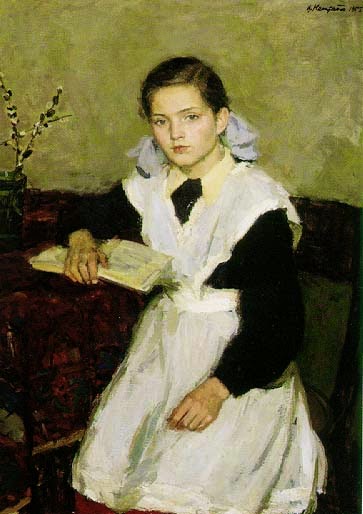
Vasili Kirillovich Nechitailo 1915-1980
painting of School Girl Ksyusha 1955

The current political scandal and concerns over an establishment cover-up is lifting the carpet on some murky ways of behaving in the past – why did nobody look deeper when, 20 years ago, Ted Heath’s former Chief Whip, Tim Fortescue, commented in the documentary, “Westminster’s Secret Service – the Role of the Whip”:
“Anyone with any sense who is in trouble would come to the whips and tell them the truth, “I am in a jam – can you help?” It might be debt, it might be scandal involving small boys or any kind of scandal that a member seems likely to be mixed up in… We would do anything we could, because we would store up brownie points. That sounds a pretty nasty reason but if we could get a chap out of trouble he will do what you ask for ever more”?
Ted Heath, former UK Prime Minister
appointed Tim Fortescue as Chief Whip
Power enables abuse.  The words of Lord Acton, written in a letter in 1887 to Bishop Mandell Creighton (but probably inspired by the words of Alphonse Marie Louis de Prat de Lamartine in his essay “France and England: a Vision of the Future” published in 1848) ring true: 
“Power tends to corrupt, and absolute power corrupts absolutely. Great men are almost always bad men.”
The experience of my own small incident has got me thinking about the abuse of power and the danger of allowing the status quo in any environment to go unchallenged when things clearly need to be changed.  There has been much psychological research into the influence of power on behaviour – one notable experiment took place in 1971, the Stanford Prison Experiment, in which a group of people, arbitrarily assigned as guards over others, swiftly began to abuse their detainees. Participants were both horrified and surprised at the manner in which they behaved. Fortunately individual human nature is not always swayed towards self-interest and sadism when people are given power over others – another, more recent piece of research, undertaken by Katherine (Katy) A DeCelles of the Rotman School of Management at the University of Toronto, looks into whether power always results in self-serving, corrupt behaviour or if there is a difference in the way some people respond compared to others. DaCelles instructed two groups, one of undergraduates and the other adult workers, explaining that they had a shared pool of 500 points and that they should select between zero and ten points for each of themselves to win a lottery. The higher the number of points the greater the probability of winning, but, in the event that members of the group claimed more points than the total available in the pool, the lottery would be cancelled. Prior to participating she asked some participants to write an essay about an ordinary day and others to describe a time when they had been in power/felt powerful. The authors of conventional days on average took 6.5 points, those who had described powerful experiences took between 7.5 points (if they had a low moral identity score) and 5.5 (if their moral identity score was high). Clearly having a moral identity (i.e. knowing your personal values and believing that there is importance in being “caring”, “fair”, “generous” and “compassionate”) has a fundamental impact on the way in which we lead and interact with others.

17th century carving
over a door of the Tōshō-gū shrine in Nikkō, Japan,
If we want to make our world, our businesses, our institutions better, with leaders who have integrity as well as influence, we need to find a way to support and encourage those with a strong moral identity. Part of the problem is perhaps that these people do not feel comfortable in the world as it is. In addition we are all prone to making judgements based on first appearances. Often those with a conscience are also self conscious and so do not create the best/most impactful initial impression within the pressurised environment of an interview or assessment centre. The best candidates can be overlooked, but Amy Cuddy, a social psychologist at Harvard Business School, believes that she has found a way to help people create a better impression, as explained in this impactful TED talk:


I find it interesting that certain physical actions result in the release of hormones that impact our stress levels and/or self-confidence and hence how others view us. Our bodies control our minds just as much as our brains control our physical movements. Amy Cuddy’s ability to turn her own life around, through applying the behaviour she espouses in her talk, is inspiring.

Areas of the brain responsible for movement
It is possible for lives to be changed and for people to do things that they perhaps never thought they would be capable of doing. I shall end where I began in this piece…at Grange Park Opera. The singer who sang the role of Herman has perhaps the most powerful voice I have ever heard. He is the American tenor Carl Tanner and his personal history is inspirational – he was born into a modest working-class family in Arlington, Virginia.  He worked as a truck driver and a bounty hunter, before deciding to pursue his dreams – with only $75 and a few clothes in a bag, he moved to the Big Apple. One evening, attracted by the sound of singing, he stopped at Bianchi and Margarita’s, a restaurant in New York City frequented by the operatic set. The owner recognised that he could sing from the manner in which he spoke and let him entertain the diners. Richard Gaddes, the head of Santa Fe Opera, was eating at the restaurant that night and was so impressed with the tone of Tanner’s voice that he offered him a role in one of his operas and so a great singing career was born. A film is soon to be made of Tanner’s story, with Jack Black playing the title role – I personally think Tanner should play himself.


Grange Park Opera production of Queen of Spades
Herman played by Carl Tanner

Life is at times stranger than fiction and that is worth remembering, as are Abraham Lincoln's words on power and adversity:
"Nearly all men can stand adversity, but if you want to test a man's character, give him power."
Crocuses pushing through snow